


Fun Fact
The original Bitcoin whitepaper never mentioned rollups, data-availability layers, or restaking. The modular movement emerged more than a decade later—proof that crypto’s most important architectural shifts often arrive long after the first breakthrough.
Modular blockchains are no longer an experiment at the edges of crypto. They are becoming the dominant design philosophy for how decentralized systems scale.
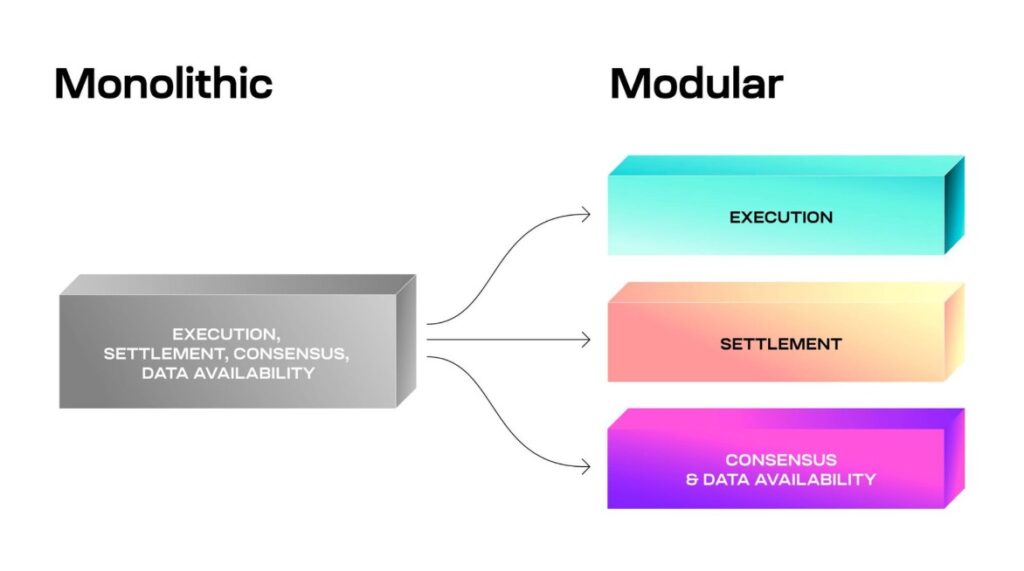
For most of its existence, the industry operated under a monolithic assumption. Bitcoin bundled execution, consensus, settlement, and data availability into one tightly coupled system. Ethereum followed the same path. One chain handled everything. One global state machine processed all activity.
That design was elegant. It was coherent. It was easy to reason about.
But it was never built for exponential usage.
As demand increased, the architectural tension became visible. Congestion was not just a temporary inconvenience—it was a structural signal. When block space becomes scarce, every function of a monolithic chain competes for the same limited capacity. Fees spike. Throughput slows. The system strains under its own all-in-one design.
The problem was not simply scaling.
It was bundling.
The monolithic ceiling
A monolithic blockchain performs four core functions at once:
- Execution (processing transactions and smart contracts)
- Consensus (agreeing on state)
- Settlement (finalizing results)
- Data availability (publishing transaction data)
In a monolithic system, these functions cannot scale independently. If execution demand surges, consensus must keep up. If data requirements expand, settlement must absorb the cost.
This creates a hard ceiling.
Ethereum’s gas crises in 2020–2021 were not isolated failures. They were architectural stress tests. A chain that does everything must optimize everything simultaneously. That constraint becomes expensive at scale.
Crypto needed an alternative model that allowed different parts of the stack to evolve independently.
The unbundling of the blockchain stack
Modular blockchains separate the four functions into distinct, specialized layers.
Execution layers (rollups, app-chains) process transactions.
Data availability layers publish and store transaction data efficiently.
Settlement layers finalize results and provide economic guarantees.
Consensus layers secure the network and maintain integrity.
Instead of vertical scaling—one chain doing more—modular systems scale horizontally. Multiple execution environments can coexist. Data layers can specialize in cost efficiency. Settlement can prioritize security and finality.
This mirrors the evolution of the internet. Early networks bundled communication and application logic. Over time, they separated into TCP/IP, HTTP, DNS, and application layers. Each layer optimized for its own function.
Crypto is following the same path: decomposition as maturity.
Why modular blockchains matter beyond throughput
It is tempting to frame modularity as a scalability solution. But that undersells its significance.
Modular blockchains introduce architectural flexibility.
Developers are no longer locked into a single chain’s constraints. They can assemble infrastructure like components:
- A gaming chain can optimize for low-cost execution.
- A DeFi protocol can prioritize settlement security.
- A data-heavy application can minimize data availability costs.
- An enterprise use case can emphasize predictable throughput.
This composability transforms blockchain design from rigid ecosystems into configurable stacks.
In monolithic systems, users choose a chain.
In modular systems, developers choose layers.
That subtle shift changes how value accrues.
If you want the deeper angle on why “smart money” narratives keep collapsing under stress, this piece breaks down The “Institutional” Myth: Why Crypto’s Biggest Bulls Are Finally Freaking Out and what it signals when the loudest believers start hedging their own story:
https://techfusiondaily.com/institutional-myth-crypto-bulls-freaking-out/
The economic reconfiguration
The modular model redistributes economic gravity.
Instead of chains competing to be “the fastest” or “the cheapest,” layers compete within their specialization:
Data availability layers compete on cost per byte and scalability.
Settlement layers compete on security guarantees and decentralization.
Execution layers compete on developer tooling and performance.
Restaking markets compete on pooled security economics.
Value no longer concentrates exclusively in a single Layer 1 token. It disperses across the stack.
This reconfiguration challenges the winner-takes-all narrative that has dominated crypto discourse for years. The question is no longer “Which chain will win?” but “Which layers will become indispensable?”
That is a fundamentally different competitive landscape.
The sovereignty vs. shared security debate
Modularity introduces a philosophical divide.
Some ecosystems prioritize sovereign app-chains—networks that control their own governance, upgrades, and economic design. Others rely on shared security models, where smaller chains inherit trust from a larger base layer.
Sovereign chains offer flexibility and autonomy.
Shared security offers economic efficiency and inherited trust.
Modular blockchains amplify this tension rather than resolve it.
The future likely includes both. Sovereignty for specialized use cases. Shared security for capital-intensive or trust-sensitive applications.
The architecture becomes pluralistic.
Complexity as a trade-off
Modularity solves bundling constraints—but introduces systemic complexity.
Cross-rollup communication remains fragmented. Bridging liquidity across execution layers is still clunky. Data availability layers must prove long-term durability under sustained load. Restaking mechanisms introduce correlated slashing risks that the ecosystem is still modeling.
Security assumptions differ across layers. An application may inherit settlement security but depend on a separate data layer with its own risk profile.
In monolithic systems, risks are centralized.
In modular systems, risks are distributed—and sometimes opaque.
The industry is building multi-layered systems faster than it fully understands their emergent interactions.
That is not necessarily reckless. It is characteristic of infrastructure cycles. But it does mean modularity is direction, not destination.
The long arc of modularity
This is not the first time crypto experimented with modular ideas.
Bitcoin’s Lightning Network separated payment execution from base settlement.
Sidechains explored layered trust assumptions.
Plasma attempted early execution separation.
Cosmos introduced sovereign app-chain architecture years before rollups matured.
What has changed is tooling and coordination.
Data availability sampling has become practical.
Zero-knowledge proofs have matured.
Interoperability frameworks have improved.
Developer ecosystems have expanded.
Modularity is no longer conceptual. It is operational.
Why this story is evergreen
Most crypto narratives decay with market cycles.
NFT manias fade.
Token incentives distort short-term metrics.
Throughput marketing shifts focus every year.
Architecture does not decay.
Modular blockchains represent an engineering direction grounded in scalability physics and economic efficiency. Whether markets are bullish or bearish, decentralized systems must handle increasing demand without compromising security.
That necessity does not depend on token price. It depends on usage.
Which is why this shift will likely outlive multiple cycles.
A structural consequence few discuss
As modular systems mature, Layer 1 chains risk becoming commodities.
If execution migrates to rollups, and data availability migrates to specialized layers, the base chain’s role narrows to settlement and consensus.
That role is powerful—but less visible.
In such a world, value capture may depend less on user-facing adoption and more on infrastructure indispensability.
The narrative shifts from “Which chain has the most users?” to “Which layer cannot be replaced?”
That is a quieter but more durable form of dominance.
The uncomfortable question
If modular blockchains continue to fragment execution, data availability, and settlement into interchangeable components, what happens to the idea of a single dominant chain—and how long before the market realizes that long-term value may reside not in individual networks, but in the architecture that binds them together?
Sources
Celestia documentation
Ethereum rollup ecosystem documentation
Originally published at https://techfusiondaily.com