

Fun Fact
In 2019, when India floated a shared AI governance framework, most Western diplomats treated it like a polite academic exercise — not a power move.
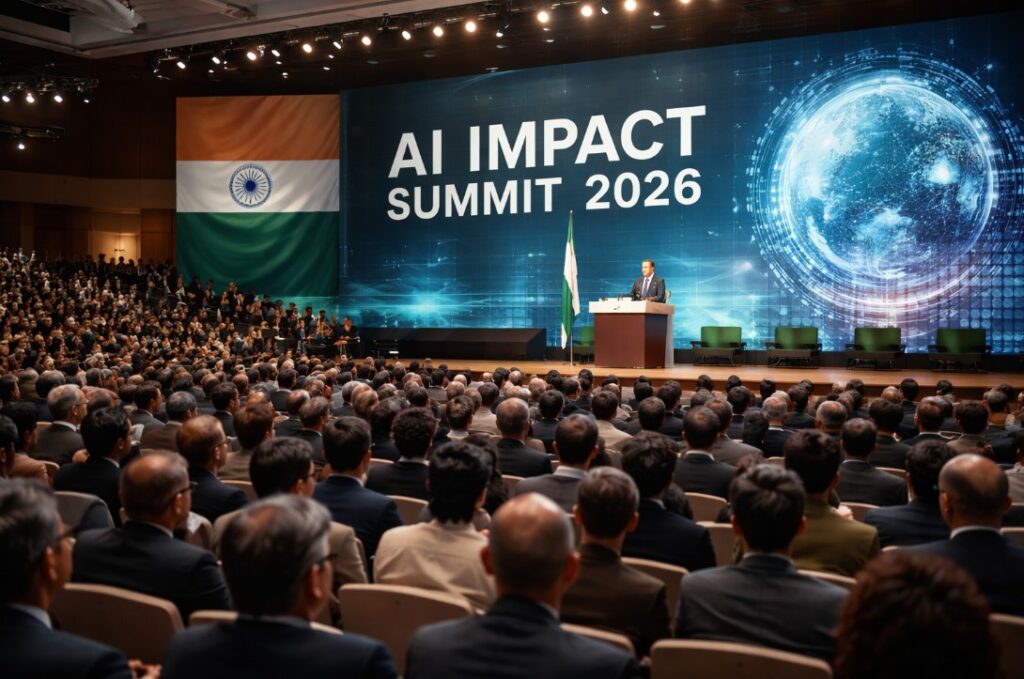
The AI Impact Summit 2026 wasn’t a tech conference. It was a positioning exercise. The AI Impact Summit 2026 felt less like a gathering of innovators and more like a country testing how much authority the old AI order has left.
And the answer, quietly, is: less than it thinks.
New Delhi didn’t host this to impress anyone. It hosted it because the traditional AI power centers are distracted — by elections, by internal gridlock, by corporate lobbying cycles that never really end. When leadership fragments, someone eventually fills the gap.
India decided it was tired of waiting.
Not because it suddenly discovered AI.
Because it realized governance is up for grabs.
Geopolitics: this wasn’t symbolism, it was leverage
Let’s stop pretending the geopolitical layer was subtle.
The United States arrived with ambition and domestic paralysis wrapped in the same speech. Europe brought regulatory frameworks that look decisive on paper and negotiable in practice. China didn’t need theatrics; its parallel AI ecosystem already functions as a gravitational field.
India read the room differently.
It didn’t posture as a rival superpower. That would’ve been naive. It positioned itself as a coordinator — a country capable of speaking to Washington without submission, engaging Beijing without panic, and still claiming credibility with the Global South.
That’s not moral language. That’s power language.
And here’s the part that matters: nobody openly rejected that framing. That silence wasn’t courtesy. It was recognition that the AI map is fragmenting.
When the center weakens, coordination becomes power.
Governance: the topics Big Tech prefers to “iterate on later”
The governance discussions were tense — even when the panels tried to keep things polite.
India pushed issues companies usually delay under the banner of “ongoing refinement”:
- child-safety failures in generative systems
- model opacity conveniently labeled proprietary
- cross-border compute concentration
- labor displacement that is already measurable
This wasn’t ethics theater.
It was an argument about who absorbs risk.
India signaled it doesn’t want Europe’s rigidity or America’s drift. It wants something enforceable. Not perfect — enforceable. There’s a difference.
At one point, a senior official said India doesn’t want to be the world’s AI factory. It wants to be the world’s AI conscience.
That line wasn’t inspirational. It was strategic.
Because if India can frame governance as moral infrastructure rather than regulatory overhead, it shifts negotiations entirely.
And yes, that makes Silicon Valley uncomfortable.
If you want the deeper angle on why “smart money” narratives keep collapsing under stress, this piece breaks down Anthropic Makes Its Move: A Strategic Expansion Into India to Challenge OpenAI and Google and what it signals when the loudest believers start hedging their own story:
https://techfusiondaily.com/anthropic-expands-india-ai-strategy/
Economic reality: automation is no longer hypothetical
Here’s the part nobody really wanted quoted.
Administrative roles across parts of Asia, Africa, and Latin America are already shrinking under automation pressure. These aren’t speculative job-loss charts. They’re internal restructurings.
India didn’t deny that.
It acknowledged the contradiction head-on: the countries most exposed to labor displacement are the same ones being told to “move faster.”
That tension won’t stay polite forever.
India’s strategy appears to be moving upstream — investing in AI training capacity, deployment ecosystems, and policy authorship. Not just being a services hub. Not just being the backend.
That pivot is structural.
If successful, it reshapes how emerging economies negotiate AI infrastructure instead of merely consuming it.
The Global South: from rollout zone to negotiating bloc
For years, much of the Global South functioned as a proving ground for half-finished digital products. Scale first. Governance later.
This summit hinted at something different.
Delegations from Kenya, Brazil, Indonesia, South Africa, and Mexico weren’t treated like market extensions. They were engaged as stakeholders in rule-setting.
That shift is quiet — but destabilizing.
Because once coordination among these economies solidifies, AI governance stops being a trilateral contest between the United States, Europe, and China.
It becomes multipolar.
And multipolar systems are harder to dominate, harder to predict, and harder to control.
History doesn’t move smoothly when power redistributes. It lurches.
The uncomfortable question
If the AI Impact Summit 2026 signals that governance is up for negotiation, then the old AI hierarchy isn’t reforming.
It’s eroding.
The real question isn’t whether India can lead.
It’s whether the traditional AI powers are prepared for a world where they no longer write the rules alone — and can’t quietly assume they will.
Sources
Government of India — official materials
Industry statements from participating companies
Originally published at https://techfusiondaily.com