
Fun Fact: The largest corporate nuclear energy agreement in history wasn’t signed
by a utility company or a government. It was signed by Microsoft — a software company
— with Constellation Energy through 2040, committing 2 gigawatts of dedicated nuclear
capacity to power its data centers.
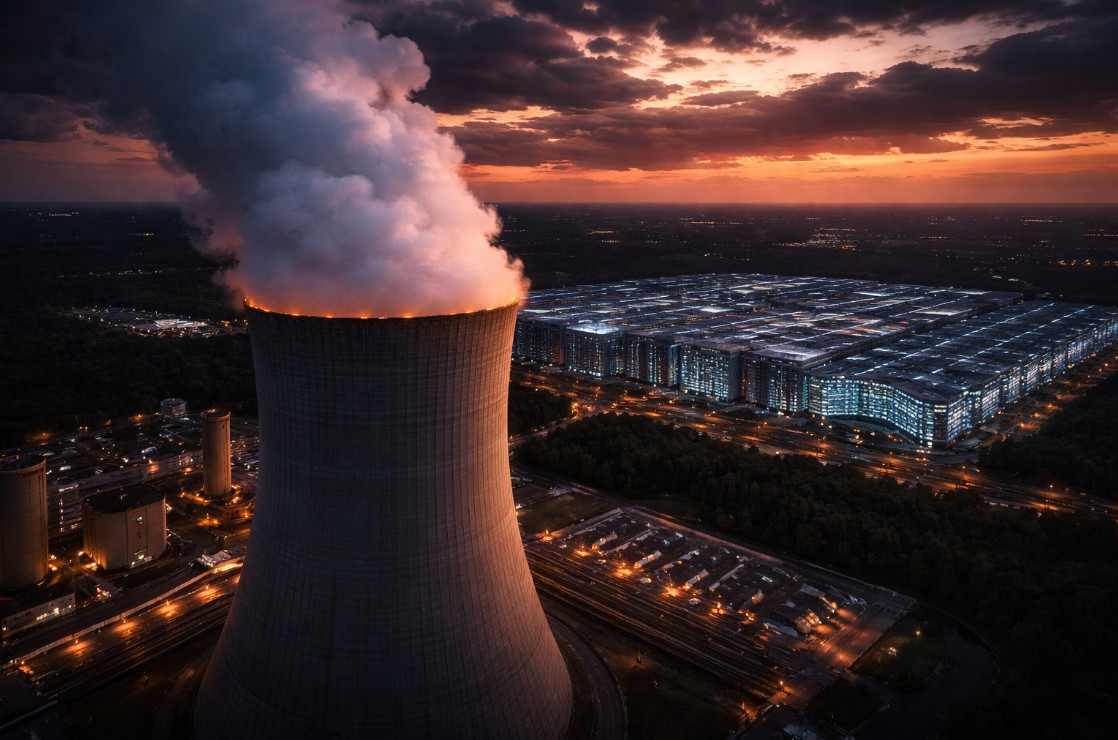
Nuclear energy AI data centers are no longer a futuristic concept — they’re the infrastructure bet that’s quietly reshaping who controls the backbone of the AI economy. Electricity has become the new oil. And the companies that figured this out first
are moving fast.
Microsoft, Google,
Amazon, and Meta have spent the last twelve months quietly
locking in nuclear power agreements that would have seemed absurd five years ago.
Not because they suddenly fell in love with atoms — but because the AI boom has run
straight into a hard physical limit: the grid can’t keep up, and renewable energy
alone can’t solve a problem that requires power around the clock, every single day.
The Numbers Behind the Nuclear Energy AI Data Centers Race
`The International Energy Agency projects global data center electricity consumption will hit 1,100 terawatt-hours in 2026 — roughly equivalent to Japan’s entire national power output. That’s an 18% upward revision from estimates made just months ago. U.S. power demand is on track to hit record highs in both 2026 and 2027, with nuclear energy AI data centers cited as one of the primary drivers.
A single AI data center can require up to 5 gigawatts of continuous power. A traditional nuclear reactor produces around 800 megawatts. The math alone explains why these companies aren’t just buying energy — they’re trying to build an entirely new supply chain for it.`
What Each Company Is Actually Doing
Microsoft’s move is the most aggressive in the nuclear energy AI data centers race. The company signed a 2 GW nuclear commitment with Constellation Energy through 2040 — the largest corporate nuclear deal ever recorded — and is backing the restart of the Three Mile Island reactor in Pennsylvania, targeting 2028. That’s the same plant that became a symbol of nuclear anxiety in 1979. Now it’s being rebranded as AI infrastructure.
Google has a development agreement with Kairos Power for 500 MW of small modular
reactor capacity. It’s also part of the NextEra-TerraPower partnership announced this
week, which targets sites in Iowa and the Southeast U.S. for the first SMR fleet
designed specifically to power AI workloads.
Amazon secured 1.9 gigawatts from Talen Energy’s nuclear plant in Susquehanna,
Pennsylvania, through 2042. It also led a $500 million financing round for X-energy,
a company developing gas-cooled small modular reactors, with a target of at least
5 GW of capacity by 2039. Meta, meanwhile, has quietly assembled commitments that
could reach up to 6.6 GW of nuclear capacity by 2035 — through deals with Vistra,
Constellation Energy, Oklo, and TerraPower.
To better understand how long-term infrastructure bets are reshaping modern technology platforms, this deep dive into Why Most People Are Using ChatGPT Wrong — And the Gap Is Getting Wider explores why scale, energy, and timing are becoming decisive factors in the future of computing:
https://techfusiondaily.com/prompt-engineering-using-chatgpt-wrong/
Why Nuclear and Not Renewables
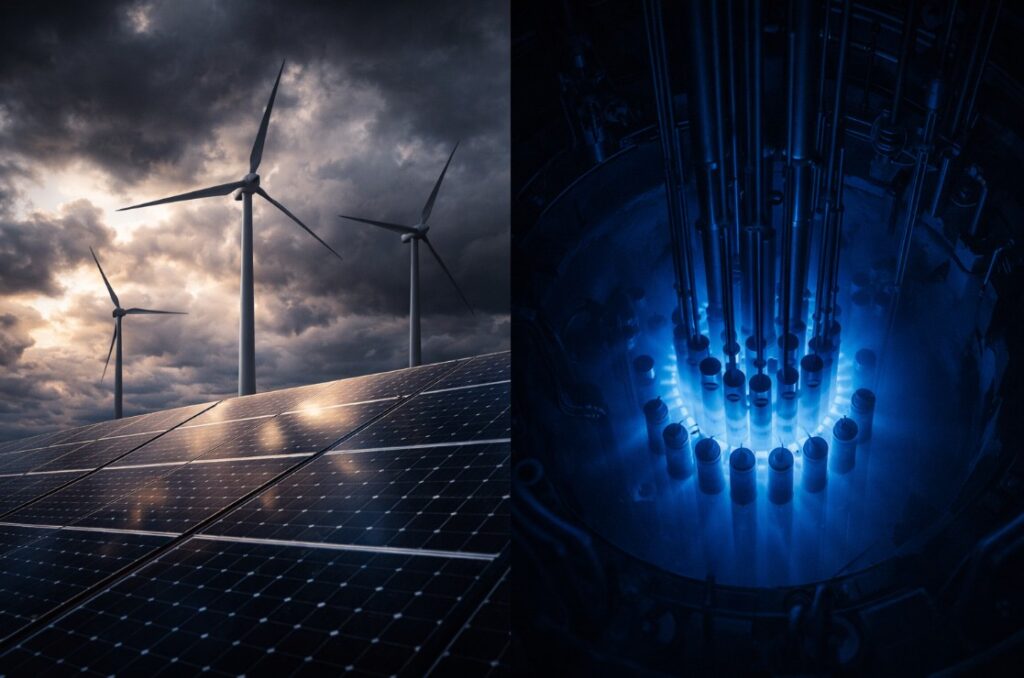
`The honest answer is reliability. Solar and wind produce power when conditions allow. Nuclear produces power continuously — which is exactly what a nuclear energy AI data center running inference at scale needs at 3 AM on a Tuesday in January.
Nuclear power for AI data centers also costs significantly more than alternatives. Meta’s agreements reportedly price nuclear energy at $141 to $220 per megawatt-hour, compared to $50 to $60 for gas, wind, or solar. These companies are paying a significant premium — and doing it deliberately, because intermittent power is not a viable option when the workloads never stop.`
The Infrastructure Layer Nobody Is Talking About
The real story here isn’t energy policy. It’s market structure.
The companies signing these deals aren’t just securing electricity — they’re securing
a competitive moat. If Microsoft locks in 2 GW of nuclear capacity through 2040 and
a competitor can’t get reliable power for a new data center region, that’s not an
energy problem. That’s a market access problem.
Texas regulators are already exploring rules that would require data centers to bring
their own power supply or accept forced load reductions during peak demand. When
regulators start designing special constraints around one industry, the infrastructure
gap is already real — and the companies that moved first will be the ones still
running at full capacity when everyone else is managing curtailments.
`Nuclear capacity takes years to build. The SMRs being financed today won’t come online until the late 2020s at the earliest — and that’s if permitting, construction, and commissioning stay on schedule, which nuclear projects historically don’t. The companies writing these checks aren’t buying power for today. They’re buying the right to run nuclear energy AI data centers at scale in a decade when the grid will be far more constrained than it is now.
The question is whether the rest of the industry woke up to this early enough — or whether the window to lock in firm, reliable power for the next generation of AI infrastructure is already closing.`
Sources
Reuters — April 10, 2026 reporting on Big Tech nuclear energy deals and AI power demand
IEA — Global data center electricity consumption projections, 2026