
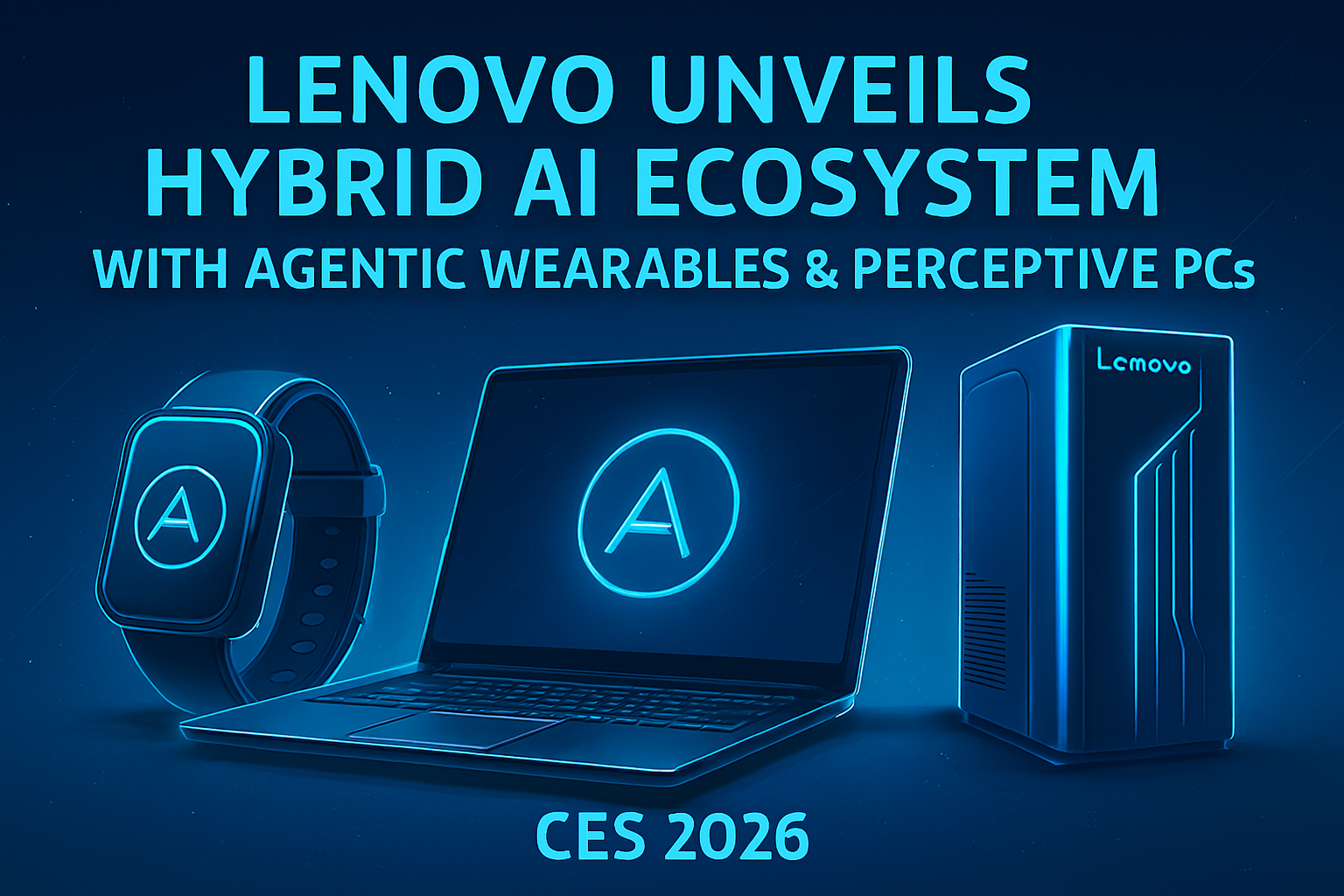
At CES 2026, Lenovo surprised the tech world by unveiling a full-stack Hybrid AI ecosystem designed to bridge the gap between personal computing, ambient intelligence, and enterprise-grade inference. The announcement included three major pillars: agentic-native wearables, perceptive PCs, and inferential servers — all powered by Lenovo’s new AI-native architecture called NeuroCore.
This marks Lenovo’s most ambitious innovation push since its entry into foldable laptops in 2020. The company is now positioning itself as a leader in ambient AI, with devices that don’t just respond to users — they anticipate, adapt, and collaborate.
What Is Hybrid AI?
Hybrid AI refers to systems that combine local inference (on-device processing) with cloud-based large model access. Lenovo’s approach allows devices to run lightweight agentic models locally while tapping into more powerful LLMs or multi-agent systems in the cloud when needed.
This architecture enables:
- Faster response times
- Lower latency for real-time tasks
- Enhanced privacy (local processing)
- Seamless transitions between offline and online modes
Agentic Wearables: AI That Moves With You
Lenovo’s new line of agentic-native wearables includes smart bands, glasses, and even a modular AI pendant. These devices run compact agentic models that learn user routines, anticipate needs, and interact with other devices autonomously.
Key Features:
- Contextual awareness: Detects location, mood, and activity
- Multi-agent collaboration: Syncs with PCs, phones, and smart home devices
- Privacy-first design: Local inference with encrypted cloud fallback
- Adaptive UI: Changes interface based on user behavior and environment
Lenovo claims these wearables can act as “personal AI companions” that evolve with the user over time.
Perceptive PCs: Beyond Smart Computing
The second pillar of Lenovo’s Hybrid AI strategy is the Perceptive PC — a new category of laptops and desktops that use ambient sensors, agentic models, and real-time inference to adapt to the user’s workflow.
Capabilities:
- Eye-tracking and gesture input
- Real-time summarization and suggestion engines
- Multi-modal input fusion (voice, touch, gaze)
- Agentic task automation (e.g., auto-organizing files, scheduling meetings)
These PCs are designed to function as co-pilots, not just tools — anticipating user needs and offering proactive assistance.
Inferential Servers: Enterprise-Grade AI Backbone
For enterprise and cloud applications, Lenovo introduced its Inferential Server Line, optimized for multi-agent orchestration and low-latency inference. These servers support:
- Agentic workflows across departments
- Real-time decision support systems
- Federated learning and privacy-preserving AI
- Scalable deployment of AI-native apps
Lenovo is targeting sectors like healthcare, finance, and logistics, where real-time AI decisions can drive massive efficiency gains.
NeuroCore: The Brain Behind It All
All three product lines are powered by NeuroCore, Lenovo’s new AI-native architecture. NeuroCore supports:
- Local agentic execution
- Cloud model integration
- Multi-agent coordination
- Contextual memory and personalization
NeuroCore is designed to be modular, allowing developers to build AI-native apps that scale across wearables, PCs, and servers.
Industry Impact
Lenovo’s Hybrid AI ecosystem could reshape how users interact with technology. Instead of isolated devices, users will experience a fluid, ambient AI environment that adapts to their needs across contexts.
Potential Benefits:
- Reduced cognitive load
- Enhanced productivity
- More natural human-computer interaction
- Stronger privacy controls
- Seamless device interoperability
Competitive Landscape
Lenovo’s move puts pressure on competitors like:
- Apple (with its Vision Pro and on-device Siri upgrades)
- Microsoft (Copilot integration across Windows and Office)
- Google (Pixel AI and Gemini integration)
- Meta (AI wearables and ambient computing research)
By offering a full-stack solution, Lenovo may leap ahead in the race to ambient intelligence.
Release Timeline
Lenovo confirmed that:
- Agentic wearables will launch in Q3 2026
- Perceptive PCs will roll out in Q4 2026
- Inferential servers are available for enterprise partners starting February 2026
Conclusion
Lenovo’s Hybrid AI ecosystem represents a bold step toward ambient, agentic computing. With NeuroCore at its center, the company is betting on a future where devices don’t just respond — they collaborate, anticipate, and evolve. CES 2026 may be remembered as the moment Lenovo redefined the boundaries of personal and enterprise AI.
Official Video – Lenovo Tech World @ CES 2026
Fun Fact
Lenovo’s first AI-powered wearable prototype was developed in 2018 — but never released publicly.