
Fun Fact
Meta’s crawlers generate billions of metadata requests every single day. At global scale, even a microscopic behavioral change in how those requests are made can ripple through thousands of independent servers within minutes.
A creator refreshes their Facebook post again.
The preview is blank.
They check the article. The image loads perfectly on the website.
They revalidate Open Graph tags. Everything looks correct.
They clear cache. Nothing changes.
They open their hosting panel. No errors.
They try sharing again from mobile. Still broken.
A quiet thought creeps in:
“What did I break?”
In most cases like this, the answer is uncomfortable — because it isn’t you.
It’s infrastructure.
When the Web Breaks Quietly
Every few years, thousands of websites begin failing in eerily similar ways:
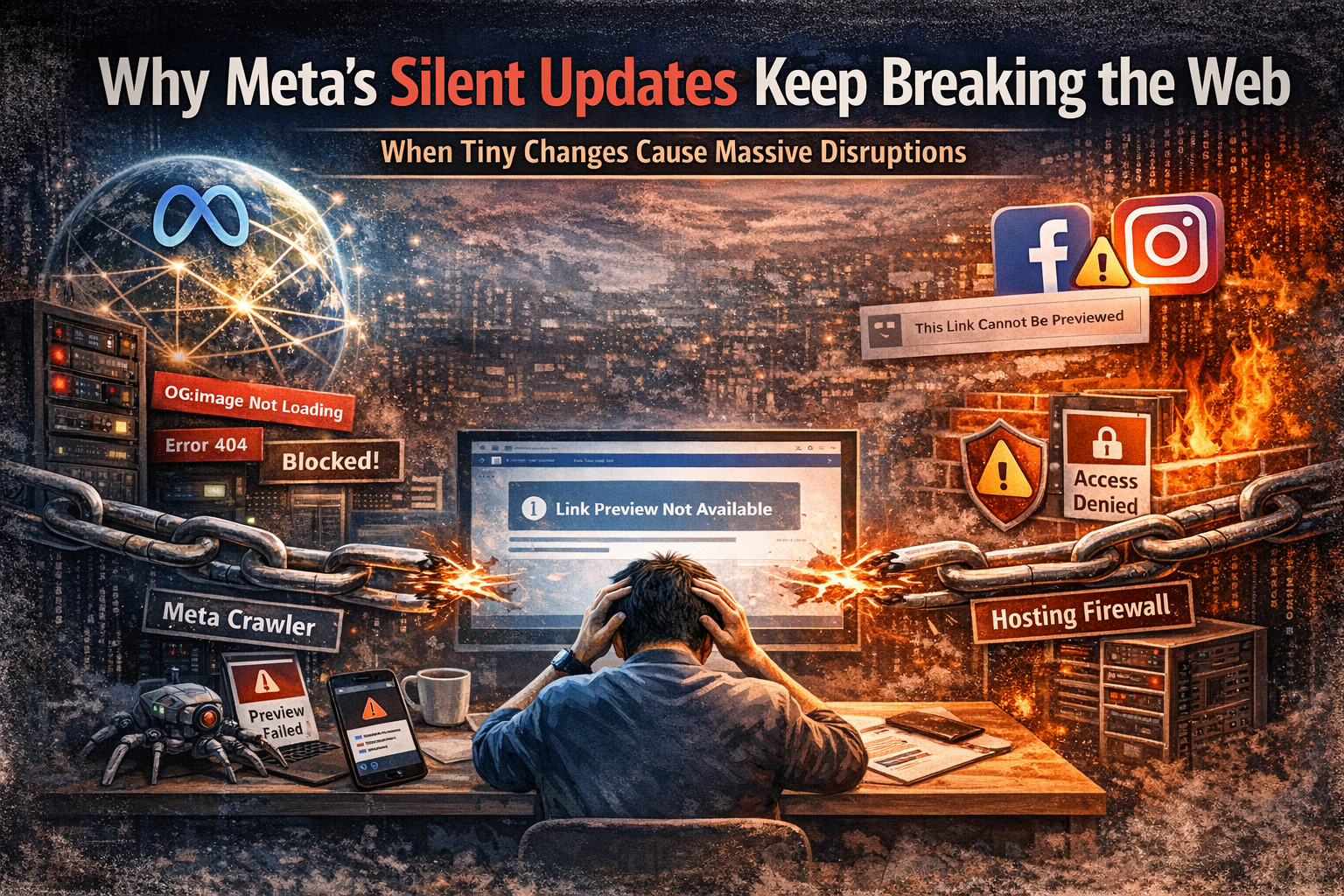
- OG:image not loading
- “This link cannot be previewed”
- Blank Facebook previews
- Instagram ↔ Facebook sync failures
- Meta crawler blocked by hosting firewalls
- Publishing tools behaving unpredictably
To each individual publisher, it feels personal. Isolated. Random.
In reality, it’s usually systemic.
Over the past several years, silent adjustments in Meta’s crawler and tracking infrastructure have repeatedly triggered chain reactions across the open web. These aren’t malicious actions. They are engineering decisions operating at planetary scale.
But scale changes consequences.
If you’re following how Meta’s ecosystem is evolving beyond software updates, this deep dive into Ray-Ban Meta Gen 1 vs Gen 2: What Actually Changed This Year? provides essential context for understanding the company’s broader hardware and platform strategy:
https://techfusiondaily.com/ray-ban-meta-gen-1-vs-gen-2-what-changed/
The Collision of Two Automated Systems
Here’s what typically happens behind the scenes.
Meta updates how its crawler fetches metadata — perhaps modifying request frequency, validation timing, or header structure.
Hosting providers rely on automated protection systems designed to detect abnormal traffic patterns. These systems monitor:
- Request frequency
- IP clustering
- Metadata fetch bursts
- Repeated asset retrieval
If behavior deviates from expected norms, rate-limits activate automatically.
Shared hosting environments are especially sensitive because thousands of domains sit behind the same protective layer.
So when a crawler at Meta’s scale subtly changes behavior, server defenses sometimes interpret the shift as suspicious.
The result:
- Temporary IP blocking
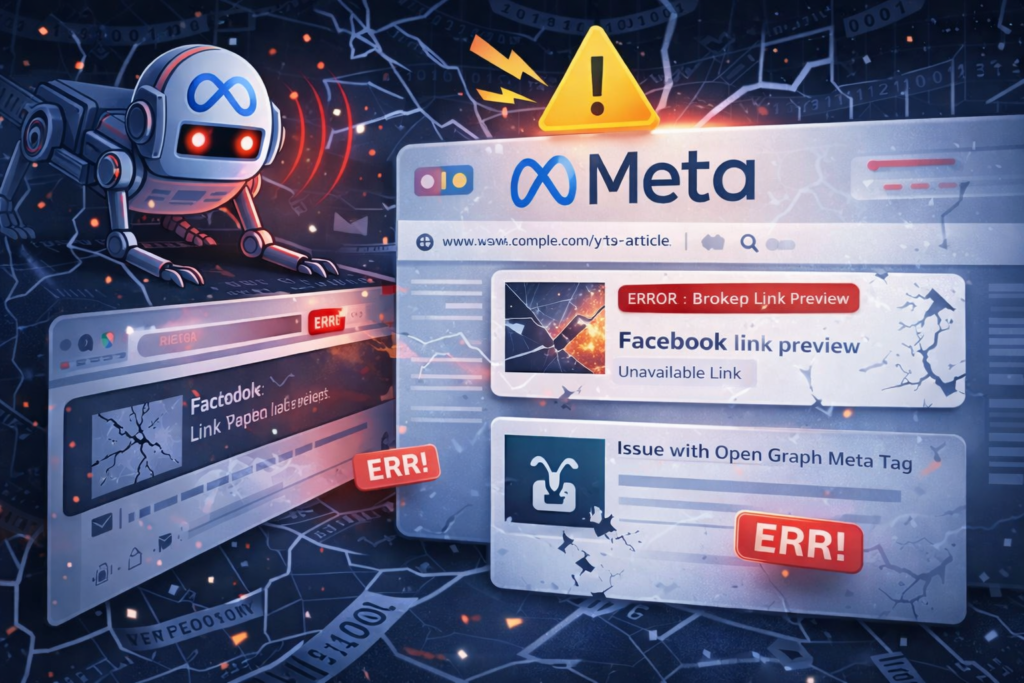
- Broken previews
- Failed metadata pulls
- API disruptions
No human pressed a “break the web” button.
Two automated systems simply collided.
A Pattern That Keeps Repeating
This isn’t new.
2021 — Open Graph Parsing Failure
A backend change caused Facebook to misread OG metadata. Millions of sites displayed blank previews globally.
2022 — Crawler Frequency Increase
Hosting firewalls flagged increased Meta traffic as bot abuse, blocking legitimate requests.
2024 — Account Center API Sync Disruption
Facebook Pages temporarily disappeared from Instagram integrations after API changes.
2025 — Anti-Spam Verification Overreach
Thousands of legitimate domains were flagged as unsafe after a link-verification update.
Each case followed the same arc:
- Silent internal adjustment
- Automated defensive reaction
- Global confusion
- Gradual stabilization
None were catastrophic.
All were revealing.
Why Independent Creators Feel It More
Large media organizations have buffers:
- Direct traffic
- Email subscribers
- Brand recognition
- Strong backlink ecosystems
- Diversified distribution
Independent blogs often don’t.
They rely heavily on:
- Facebook sharing
- Instagram Stories with link stickers
- Reels driving traffic
- Cross-posting between accounts
- Visual previews that attract clicks
When previews fail:
No image = fewer clicks.
Fewer clicks = fewer sessions.
Fewer sessions = weaker engagement signals.
Search engines monitor engagement patterns.
A sudden dip in social traffic can ripple outward.
For a new blog, momentum is fragile.
A 48-hour distribution interruption can feel existential.
The Psychological Cost No Dashboard Shows
Here’s what doesn’t appear in infrastructure reports.
That creator refreshing the page at 11:47 PM?
They might have:
- A product launch scheduled
- An affiliate campaign running
- An ad budget active
- A sponsor expecting traffic
- Rent due next week
For a corporation, a crawler update is a data point in a deployment log.
For an independent publisher, it can mean:
- Lost revenue
- Lost sleep
- Lost confidence
The web markets itself as decentralized and empowering.
But visibility flows through private pipes.
And those pipes can change shape without notice.
The Centralization Paradox
The modern internet feels open.
In reality, distribution is highly centralized.
A small group of infrastructure giants shapes how content is discovered and monetized:
- Meta
- Amazon
- Microsoft
- Cloudflare
When any of them adjusts internal systems, millions of independent websites absorb the shockwaves.
The open web depends on closed ecosystems.
That isn’t ideology. It’s architecture.
This Isn’t About Blame — It’s About Responsibility
Platforms innovate constantly. They must.
Security evolves. Spam evolves. Infrastructure scales.
But when innovation happens at planetary scale, responsibility scales with it.
The real question isn’t whether platforms should update systems.
It’s whether updates affecting global distribution should come with:
- Transparent communication
- Advanced notice to hosting providers
- Clear documentation
- Real-time incident visibility
Because silence amplifies instability.
The Economic Impact
Even short-term preview failures can affect:
- Click-through rates
- Ad impressions
- Affiliate revenue
- Sponsored campaigns
- Product launches
Distribution is leverage.
When distribution weakens, revenue follows.
For independent creators, traffic is oxygen.
Interruptions — even temporary — can suffocate growth momentum.
The Structural Fragility We Ignore
This article isn’t about one outage.
It’s about recurring structural fragility.
As long as:
- Crawlers operate at global scale
- Hosting relies on automated rate-limits
- Distribution depends on proprietary platforms
- Visibility flows through centralized systems
…these collisions will happen again.
The details will change.
The pattern won’t.
What Can Publishers Actually Do?
There is no perfect shield. But there are buffers:
- Monitor server logs for crawler blocks
- Whitelist verified crawler IP ranges carefully
- Use more robust hosting when possible
- Build email lists
- Diversify traffic sources
- Reduce single-platform dependency
Resilience increasingly means decentralizing your own distribution — even if the infrastructure around you is centralized.
The Bigger Question
The web was built on open protocols meant to be neutral.
Somewhere along the way, visibility became conditional.
Not on quality.
Not on merit.
But on compatibility with private infrastructure decisions.
Perhaps the uncomfortable truth is this:
We don’t just publish on the web anymore.
We publish inside ecosystems.
And ecosystems have gatekeepers.
Conclusion
Meta’s silent tracking adjustments breaking previews isn’t merely a technical inconvenience.
It’s a recurring reminder that the digital infrastructure supporting independent creators is more fragile — and more centralized — than we like to admit.
This isn’t about outrage.
It’s about awareness.
Because if one quiet backend tweak can disrupt global distribution overnight, the next disruption isn’t a dramatic possibility.
It’s an architectural certainty.
Sources
TechCrunch — “Meta quietly updates tracking system, impacting website previews and API calls”
Hostinger Customer Support — Infrastructure Communication
Meta Developers Documentation
Originally published at https://techfusiondaily.com



One thought on “Why Meta’s Silent Updates Keep Breaking the Web — And Why This Is Bigger Than a Technical Glitch”