
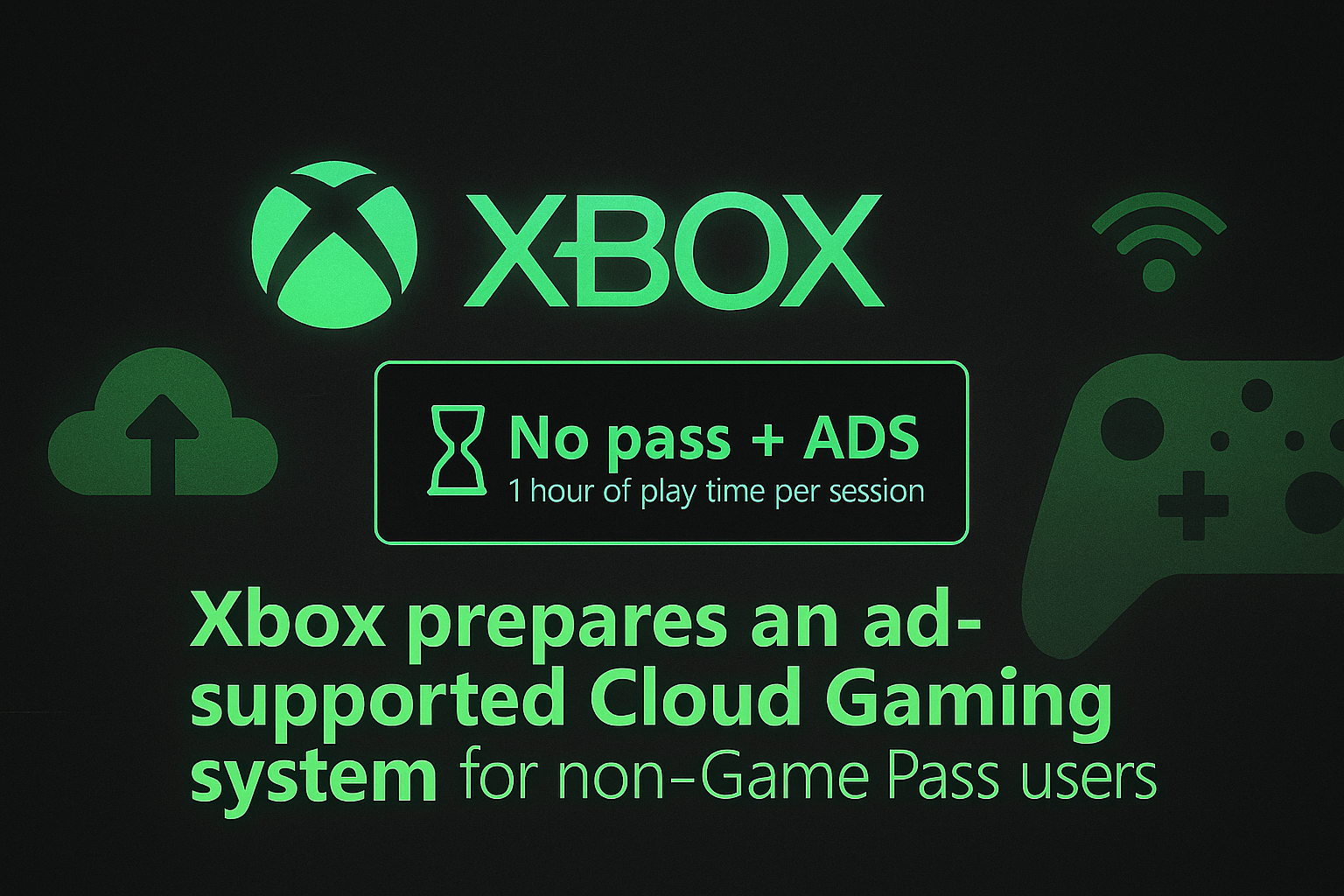
Fun Fact: Microsoft’s earliest experiments with advertising in gaming weren’t inside the cloud or even inside Xbox Live. They were literal digital billboards inside Burnout Paradise and Need for Speed back in the mid‑2000s. Nearly twenty years later, advertising returns to the Xbox ecosystem — but this time, it’s tied to cloud access, not racetrack scenery.
Microsoft is quietly preparing one of the most meaningful shifts to Xbox Cloud Gaming since the service launched. Several users recently spotted a pop‑up message inside the platform that read:
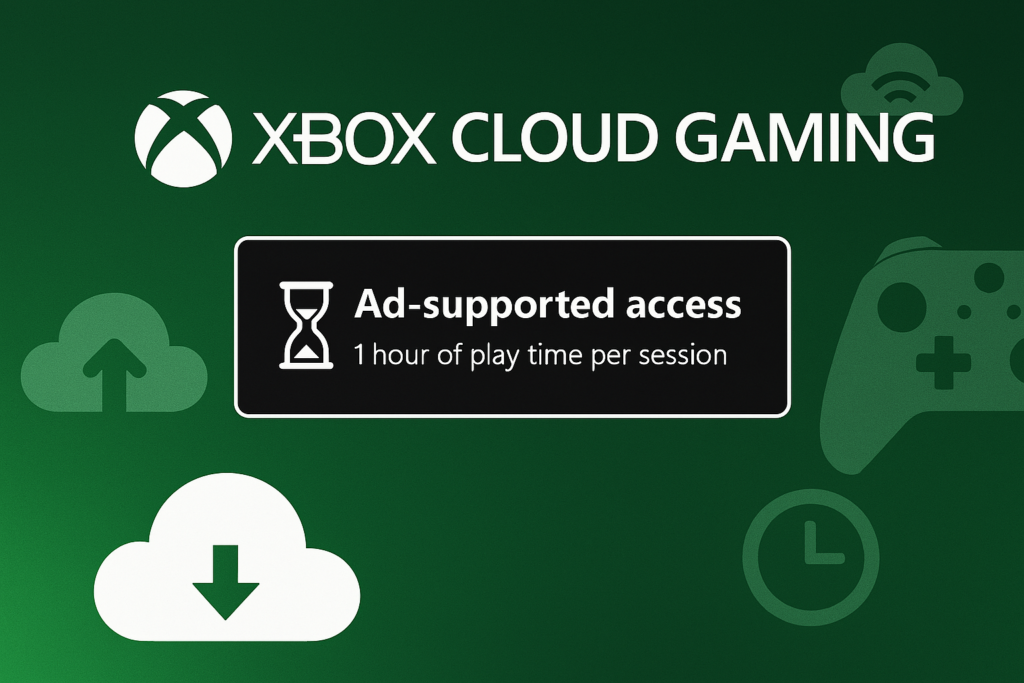
“1 hour of ad‑supported play time per session.”
Microsoft later said the message appeared “by mistake,” but let’s be honest: nothing this specific leaks accidentally. The company confirmed it is actively developing an ad‑supported tier for Cloud Gaming — a way for players without Game Pass to stream games in exchange for watching ads.
If this sounds like the streaming industry’s playbook, that’s because it is. And Microsoft seems ready to apply it to gaming in a way that could reshape how cloud access works.
A Shift Toward a Hybrid Cloud Model
For years, Xbox Cloud Gaming has lived behind the Game Pass Ultimate paywall. If you wanted to stream games on your phone, tablet, smart TV, or low‑end PC, you needed the subscription. That exclusivity helped Game Pass grow, but it also limited the reach of cloud gaming itself.
The new model Microsoft is testing looks more like a hybrid ecosystem:
- Game Pass Ultimate remains the premium, ad‑free experience.
- Players who own digital games may stream them with ads.
- Non‑subscribers could get limited, ad‑supported sessions — likely time‑boxed or session‑based.
This is the same logic that turned Hulu, Spotify, and YouTube into global platforms. Free access brings scale. Ads bring revenue. Premium tiers bring stability. And cloud gaming, which has struggled to break into the mainstream, might finally get the push it needs.
Why Microsoft Is Doing This Now
The timing isn’t random. Several forces are converging.
Game Pass growth has slowed
The subscription model isn’t collapsing, but it’s no longer skyrocketing. Microsoft needs a new funnel — a way to bring in players who aren’t ready to pay monthly.
Cloud gaming is still early
Despite years of investment, cloud gaming hasn’t hit its breakout moment. Lowering the barrier to entry could accelerate adoption, especially in markets where consoles are expensive.
Competition is heating up
Nvidia’s GeForce Now is gaining momentum. Amazon Luna is experimenting with free access. PlayStation is expanding its cloud infrastructure. Microsoft can’t afford to let cloud gaming become someone else’s territory.
Advertisers want new digital real estate
Gaming is one of the most valuable attention markets on Earth. Brands want in. Cloud gaming gives Microsoft a controlled, predictable environment to deliver ads — something traditional gaming doesn’t offer.
Put all of this together, and the ad‑supported tier stops looking like an experiment and starts looking like a strategic inevitability.
What the Ad Experience Might Actually Look Like
Microsoft hasn’t shared details, but we can make educated guesses based on how digital platforms operate.
Expect ads before and after cloud sessions, not during gameplay.
Interrupting gameplay would be a disaster — and Microsoft knows it.
More likely:
- A short video ad before your cloud session starts.
- A second ad if you extend your session.
- Occasional promotional banners inside the Cloud Gaming interface.
Think of it as the “YouTube model,” but applied to game streaming. Not ideal, but tolerable — especially if the alternative is paying $17 a month.
Why Players Might Actually Accept This
It’s easy to roll your eyes at ads in gaming, but there’s a practical upside.
Free access
Not everyone can afford Game Pass. An ad‑supported tier opens the door to millions of players who want cloud access but can’t justify a subscription.
Cloud access to purchased games
One of the biggest frustrations today: you can buy a digital game on Xbox, but you can’t stream it unless you pay for Game Pass Ultimate. That’s always felt like an artificial limitation. Ads could unlock cloud access for game owners without forcing them into a subscription.
More devices, more flexibility
Cloud gaming is the bridge between Xbox and the rest of the world’s screens. A free tier accelerates that bridge.
The Broader Industry Impact
If Microsoft moves forward — and all signs suggest it will — the rest of the industry won’t sit still.
Nvidia may need a free tier to stay competitive.
PlayStation could explore ad‑supported cloud access for PS Plus.
Amazon Luna, which already flirts with free access, might expand its offering.
And then there’s the hardware question.
An ad‑supported cloud tier makes Xbox less dependent on consoles.
That’s not a small shift — it’s a platform‑level transformation.
Cloud gaming has always been pitched as “the future,” but the economics never quite worked. Ads might be the missing piece that makes the model sustainable.
The Human Side: How Players Are Reacting
Reactions so far are surprisingly balanced.
Some players welcome the idea of free cloud access.
Others worry about intrusive ads.
A few see it as the natural evolution of digital entertainment — the same trade‑off we already make with streaming video and music.
But the most interesting reaction is the quiet one:
people who don’t love ads but will tolerate them if it means playing without paying.
That’s the audience Microsoft is targeting.
What This Means for Xbox’s Long‑Term Strategy
This move fits neatly into Microsoft’s broader vision:
- Xbox as a platform, not a device.
- Cloud gaming as a distribution layer, not a feature.
- Monetization through multiple channels — subscriptions, purchases, and now advertising.
- A future where Xbox lives on every screen, not just consoles.
If you zoom out, the ad‑supported tier isn’t about ads.
It’s about reach.
It’s about scale.
It’s about building the largest possible funnel for the Xbox ecosystem.
And once players are inside that funnel, Microsoft has a dozen ways to monetize them — none of which require selling a console.
A Final Thought
Cloud gaming has always lived in the shadow of its own ambition. The technology works, but the business model hasn’t fully clicked. An ad‑supported tier might be the bridge between what cloud gaming is today and what it could become: a universal access layer for interactive entertainment.
If Microsoft gets this right, the conversation won’t be about ads.
It’ll be about how gaming finally learned to scale like the rest of the internet.