

Fun Fact
In 2014, Samsung demonstrated its first energy-harvesting prototype that powered a small LED using radio waves. A decade later, that same principle now underpins a vision for a new class of battery-free devices that could transform industrial and consumer systems alike.
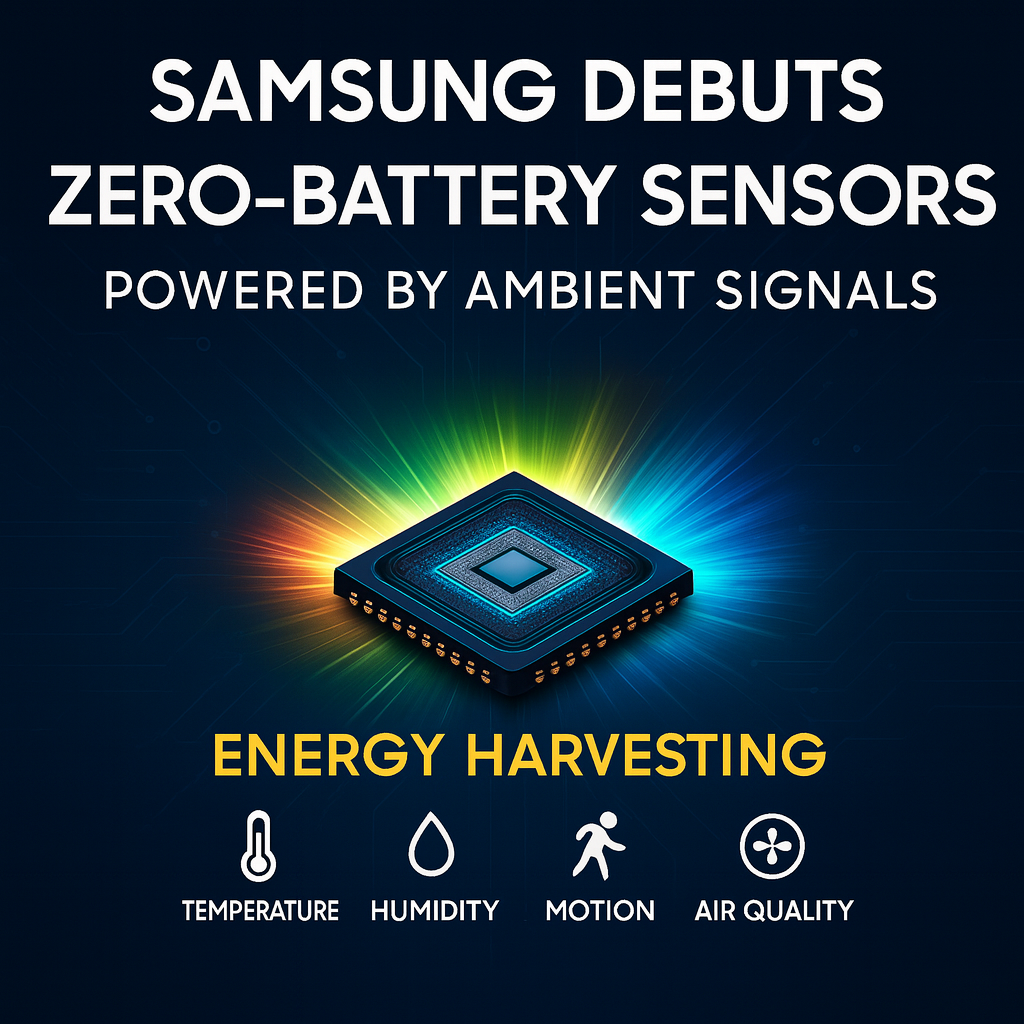
Samsung kicked off 2026 with one of its boldest hardware concepts to date: zero-battery sensors powered entirely by ambient energy. These next-generation devices—unveiled during the company’s early tech briefings—are engineered to operate indefinitely by harvesting power from everyday sources like Wi-Fi, light, motion, or even thermal changes in their surroundings.
The vision is elegantly disruptive: sensors that never need charging, never require battery replacement, and demand almost no human maintenance. In a world increasingly defined by smart devices and sprawling IoT ecosystems, that’s not just convenience—it’s critical infrastructure reform.
What Are Zero-Battery Sensors?
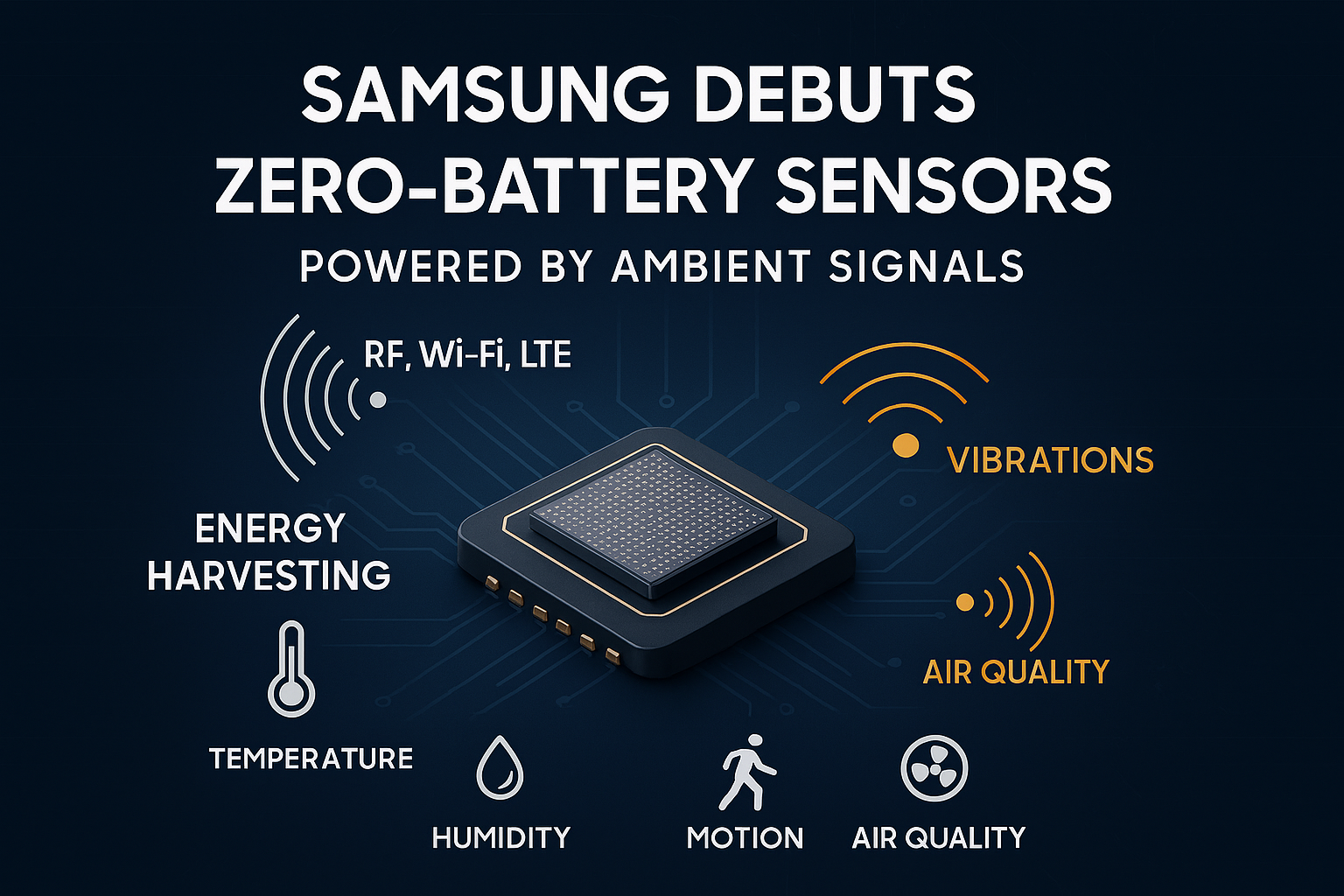
Samsung describes these sensors as ultra-efficient microdevices that capture and convert surrounding energy into power for continuous operation. They can extract energy from:
- RF signals (Wi-Fi, LTE, Bluetooth)
- Electromagnetic waves
- Mechanical vibrations
- Thermal changes
- Indoor or outdoor light
Despite their minimalist power requirements, these sensors can still perform robust tasks: monitoring temperature, humidity, motion, pressure, proximity, air quality, and more.
They don’t contain batteries. And that’s exactly the point.
Why This Breakthrough Matters
The rise of connected devices has ushered in a paradox: more automation, yet more maintenance. Most people don’t realize that batteries are the Achilles’ heel of large-scale sensor deployments. From factories to farms to hospital rooms, the logistics of battery upkeep—replacement, charging, disposal—creates a ballooning operational burden.
Multiply that by billions of devices, and the issue becomes clear: scaling the Internet of Things (IoT) with current battery-dependent systems is unsustainable, both economically and environmentally.
Samsung’s new approach proposes a future in which devices are not just smart—they’re self-sufficient.
Industrial Impact: Where These Sensors Fit First
While the potential uses for zero-battery sensors span nearly every vertical, certain industries stand to benefit more immediately:
Smart Manufacturing
Machines equipped with maintenance-free condition monitoring reduce downtime and service costs.
Healthcare
Biometric patches and patient monitoring devices that run perpetually without needing battery swaps offer new levels of reliability.
Smart Buildings
Environmental tracking in commercial spaces—temperature, CO₂ levels, occupancy—can be scaled without a wiring or battery maze.
Agriculture
Large fields equipped with weather, soil, and irrigation sensors can finally be maintained with minimal human intervention.
Logistics
Package and asset tracking tags that never run out of power ensure continuous visibility across the supply chain.
How Do They Actually Work?
Samsung outlined a triad of technologies behind the zero-battery sensor architecture:
- Energy-Harvesting Engine – Captures ambient power sources dynamically, such as fluctuating radio signals or shifting light levels.
- Ultra-Low-Power Chipset – Operates using mere microwatts, ensuring that even minimal harvested energy suffices.
- Adaptive Transmission Protocol – Modulates data communication based on available power. When energy is abundant, the device communicates frequently; when it’s scarce, it conserves intelligently.
This makes the system not only battery-free, but also self-aware and responsive to environmental conditions—a hallmark of next-generation embedded design.
The Industry Context: A Race Toward Autonomy
The move comes amid a broader shift in how tech companies view energy and automation. While most IoT solutions focus on cloud integration, Samsung’s zero-battery sensors tackle a more grounded problem: keeping billions of devices running without human intervention.
Unlike basic RFID tags or energy-harvesting wearables of the past, these sensors are intended for dynamic, data-rich environments. Their ability to adapt transmission based on energy input makes them ideal for real-world conditions where reliability matters.
This move aligns with a larger pattern in 2026: the reinvention of infrastructure for longevity. The fact that Samsung is pushing this into industrial pipelines rather than just consumer gadgets suggests the company sees zero-battery operation not as a novelty—but as the new standard.
What Samsung Didn’t Say (Yet)
The announcement was filled with promise, but also left key details unanswered. Developers, analysts, and technologists are eager to know:
- Will the sensors be programmable, or are they fixed-function devices?
- Is data processing done locally, or offloaded to the cloud?
- How will Samsung handle privacy and data ownership in adaptive systems?
- What’s the effective range and signal fidelity in low-energy environments?
- Will this remain a premium enterprise feature or scale to consumer-level IoT?
Until those questions are addressed, full industry adoption may remain tentative. But the direction is clear—and it’s ambitious.
Why Human Oversight Still Matters
One of the most interesting aspects of the launch is what Samsung didn’t attempt: replacing human control. The company was explicit that these sensors are meant to reduce friction, not remove humans from the loop.
They are tools for enhancing systems, not automating judgment. Technicians still decide how data is used, architects still define system goals, and people remain the interpreters of information.
Automation, in this case, is about letting humans focus on higher-value decisions—not on changing batteries.
The Bigger Picture: Sustainability, Scalability, and System Longevity
If these zero-battery sensors live up to their promise, they could alter the economics of large sensor networks. Not only do they cut down operational costs, but they also contribute to a more sustainable tech infrastructure by:
- Reducing battery production and disposal
- Cutting emissions tied to maintenance fleets
- Extending the functional lifespan of IoT devices
- Lowering e-waste volumes over time
For governments, municipalities, and enterprises, that’s a compelling combination—especially as regulations and sustainability metrics become more rigorous.
Final Thought
Samsung’s Zero-Battery Sensors aren’t just another incremental upgrade—they reflect a paradigm shift in how we design, deploy, and maintain intelligent systems.
If this vision becomes reality, the future of smart infrastructure may be defined not by how many devices we connect—but by how little we have to maintain them.
Sources
Samsung R&D Briefing (2026)
Industry IoT Reports (2026)
Originally published at https://techfusiondaily.com



2 thoughts on “Samsung Debuts “Zero-Battery Sensors” Powered by Ambient Signals”