

Fun Fact:
When Meta first pitched the Ray-Ban smart glasses, internal teams debated whether to call them “AI glasses” at all. They landed on smart glasses precisely because AI felt like a word that would scare off the fashion-conscious buyer they needed to crack the mainstream.
A Meaningful Camera Upgrade
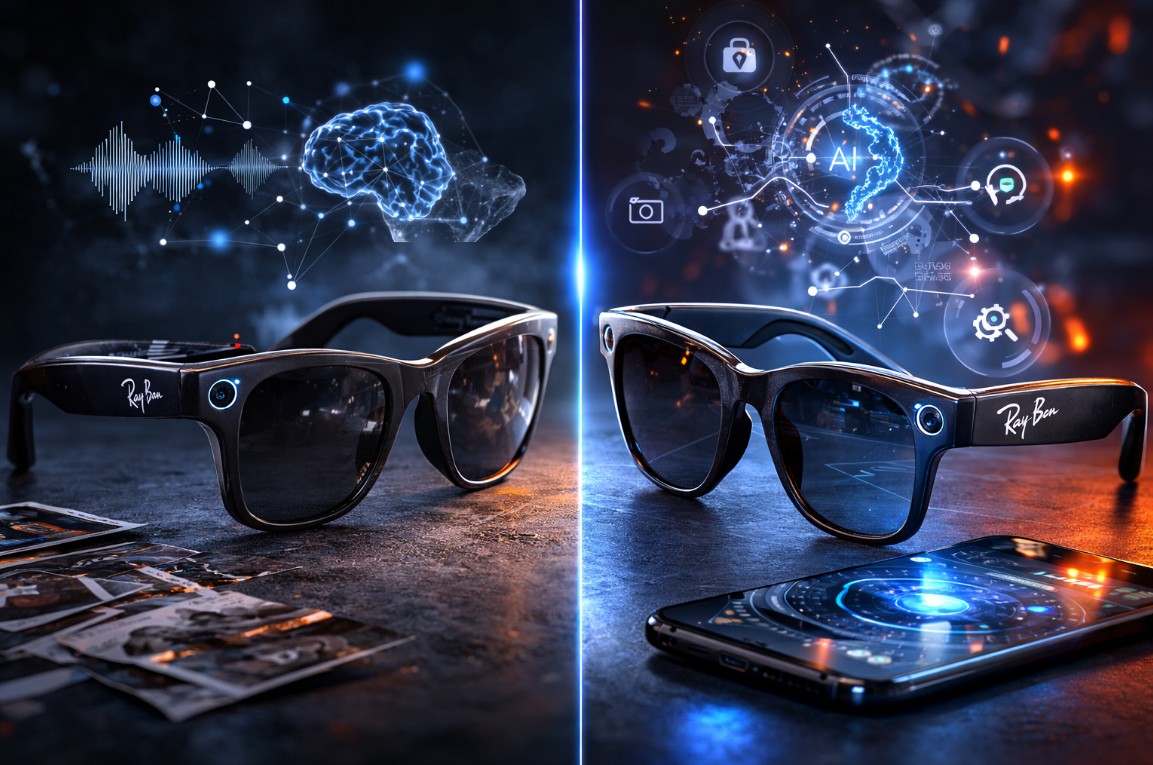
Ray-Ban Meta Gen 1 vs Gen 2 is one of the most searched comparisons in wearable tech right now — and the answer isn’t as obvious as Meta’s marketing suggests.
A Meaningful Camera Upgrade
The most noticeable difference between Gen 1 and Gen 2 is the camera — and this time, the upgrade actually matters.
Gen 1 shipped with a 12 MP ultra-wide sensor that was good enough for quick POV clips, but it struggled in low light, fast movement, and uneven exposure. The kind of conditions that describe most of real life.
Gen 2 also uses a 12 MP camera, but the experience is noticeably different thanks to better image processing, enhanced stabilization, improved HDR handling, and support for 3K video capture. The difference isn’t about numbers on a spec sheet — it’s about consistency in real-world conditions.
Photos come out cleaner, colors look more natural, and nighttime shots are actually usable. This doesn’t turn the glasses into a professional camera — and it’s not trying to. What it does is make everyday moments feel intentional rather than accidental. Clips look less like security footage and more like something you’d actually want to keep.
For creators who rely on hands-free recording, that distinction matters more than any benchmark.
Audio That Finally Feels Premium
Audio was one of Gen 1’s quiet weaknesses — and quiet is the right word, because nobody talked about it much until Gen 2 fixed it.
The speakers were fine for podcasts and short calls, but music lacked depth and sound leakage was hard to ignore in public spaces. Gen 2 introduces redesigned drivers with stronger bass, clearer mids, and better directionality.
Calls sound cleaner. Music feels fuller. And you stop feeling like you’re broadcasting your playlist to everyone within three feet. This is one of those upgrades you only fully appreciate after switching back to Gen 1 and realizing how flat the experience used to feel.
Faster, Smarter AI
Meta’s visual AI assistant — often referred to as “Look & Ask” — is where the glasses start to feel genuinely useful rather than just interesting.
On Gen 1, the feature worked, but responses were slow and object recognition could be inconsistent in ways that broke the illusion quickly. Gen 2 handles visual queries faster, offers better contextual understanding, and makes fewer mistakes in real-world scenes.
It’s still not perfect. But it’s noticeably more reliable — and that gap matters more than it sounds. Gen 2 feels much closer to what Meta originally intended when it talked about AI as a background layer rather than a party trick.
A Lighter, More Comfortable Frame
Both generations carry the unmistakable Ray-Ban design language — and that’s a deliberate decision, not a limitation.
Gen 2 is slightly lighter, with slimmer temples and improved weight distribution. The difference isn’t dramatic in your hand, but it becomes real during longer wear. Meta and Ray-Ban also expanded the lineup with additional frame styles and lens options, giving Gen 2 a more fashion-forward identity without abandoning what made the original work.
It still looks like a pair of glasses first. That’s exactly the point.
If you’ve experienced unstable link previews or unexpected Open Graph behavior, this deep analysis — Why Meta’s Silent Updates Keep Breaking the Web — And Why This Is Bigger Than a Technical Glitch — explores what may really be happening beneath the surface:
https://techfusiondaily.com/facebook-link-preview-broken-meta-updates/
Battery and Connectivity Improvements
Battery life sees a modest bump — roughly four hours on Gen 1 to around five on Gen 2. That extra hour matters less than it sounds on paper.
The real improvement is consistency. Gen 2 handles Wi-Fi and Bluetooth connections more reliably, especially when transferring photos or livestreaming. On Gen 1, that process could be unpredictable enough to become a habit-breaker.
These aren’t headline features. But in wearable tech, friction is often what determines whether a device gets used daily or ends up in a drawer after two weeks — and Gen 2 quietly removes several of those friction points.
Gen 1 and Gen 2 Availability
Even with Gen 2 now available, the first-generation model remains fully supported and easy to find. For readers comparing both versions side by side, Gen 1 is still listed through major retailers. One example can be seen here:
Ray-Ban Meta Gen 1
The newer Gen 2 model is also widely available across retail channels. A reference listing can be found here:
Ray-Ban Meta Gen 2
Both links are provided strictly for comparison purposes, not as a recommendation to purchase.
Who Should Choose Which?
Gen 1 remains a solid entry point for anyone curious about smart glasses without committing to the latest hardware. The camera is serviceable, the audio is acceptable, and the AI features work well enough for casual use.
Gen 2, however, feels better aligned with where the category is heading in 2026. Faster, more comfortable, and more dependable in the moments that actually matter. For anyone planning to wear these daily — whether for content, calls, or AI assistance — the gap between generations is real enough to feel it.
The harder question is whether smart glasses as a category are ready for daily use at all. Gen 2 makes the strongest case yet. But Meta still has work to do before the answer is obvious.
Sources
Meta Newsroom — Feature updates
Ray-Ban Official — Product specifications
Originally published at https://techfusiondaily.com Last updated: March 1, 2026

As an owner of both Gen 1 & 2. The camera and sound aren’t different in real world use. The battery in Gen 2 is a little better and offers 3k and 5 minute recording vs 3 minute in Gen 1. The biggest argument for me using Gen 1 is the ability to love stream.
Great point — and you’re right on all counts. In controlled tests the camera and audio differences are minimal for most use cases. The battery and recording time improvements in Gen 2 are real but incremental. Live streaming from Gen 1 is genuinely one of those underrated advantages that doesn’t get enough attention in reviews. Thanks for sharing that from actual ownership experience — that’s exactly the kind of real-world context that’s hard to find.