
🤖 Fun Fact
For years, the assumption was simple: AI would get smarter, faster, more useful — but still remain a tool.
GPT-5 is the first model that seriously challenges that assumption.
The Next Leap in AI Is Closer Than You Think
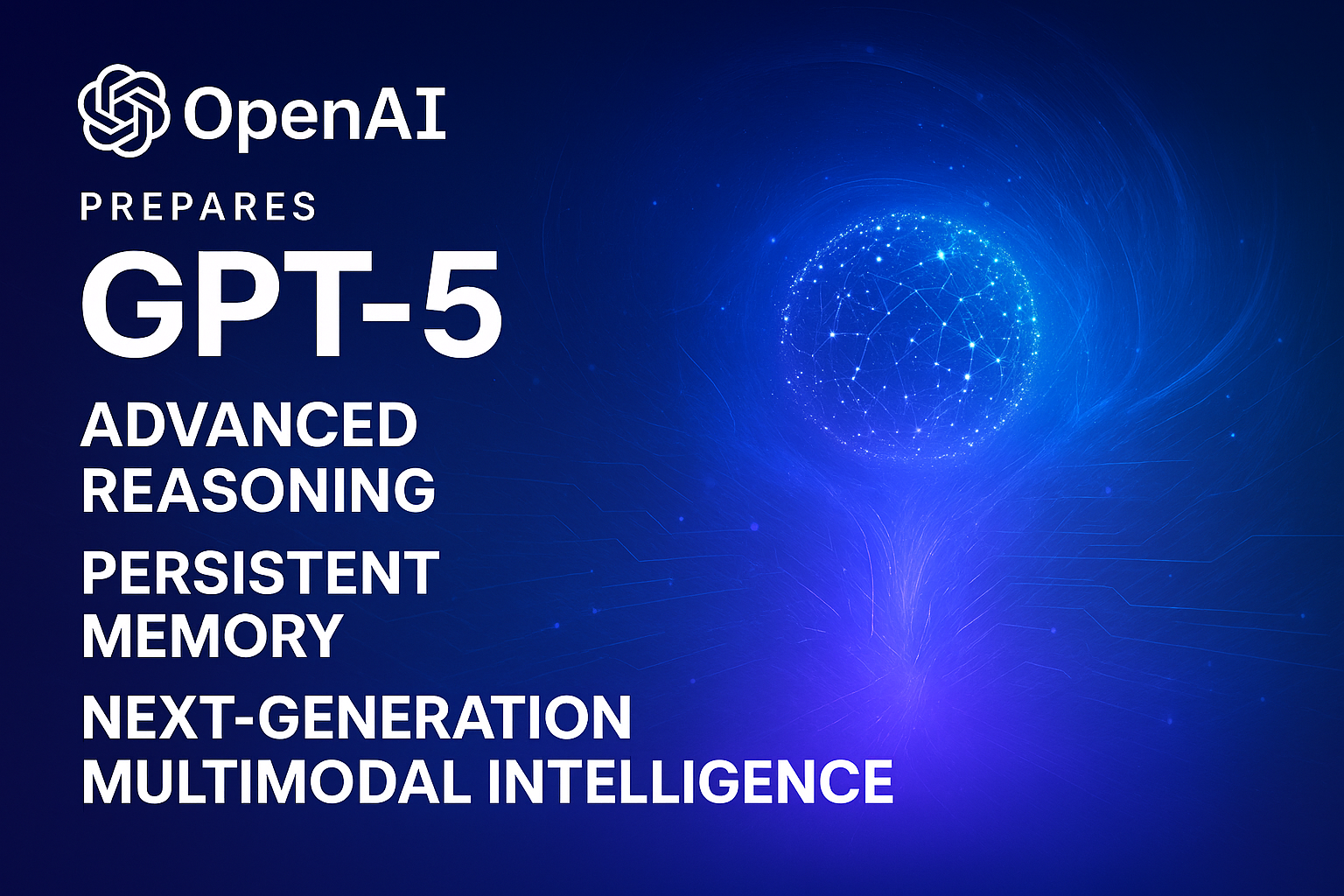
OpenAI is reportedly preparing the launch of GPT-5, the long-awaited successor to GPT-4 and GPT-4.1.
Leaked research notes, partner feedback, and industry chatter all point in the same direction — but with a familiar warning:
We’ve heard big promises before. This time, the underlying capabilities may finally justify them.
GPT-5 isn’t expected to be just “better answers.”
It’s expected to change how AI participates in work.
Longer memory.
True multimodal understanding.
Less micromanagement.
No official release date yet, but multiple signals suggest GPT-5 is already in late-stage training and internal evaluation.
A Major Leap in Reasoning Capabilities
One of the most significant improvements expected in GPT‑5 is its advanced reasoning engine, designed to outperform previous models in logic, planning, and multi‑step problem‑solving. Early reports indicate that GPT‑5 may include:
- Stronger chain‑of‑thought reasoning
- Better mathematical and scientific accuracy
- More reliable multi‑step planning
- Improved ability to follow complex instructions
- Enhanced consistency across long conversations
These upgrades would address some of the most common limitations of GPT‑4, particularly in tasks that require deep reasoning or long‑term coherence.
Researchers familiar with the model suggest that GPT‑5 may incorporate new training techniques that allow it to maintain context more effectively, reduce hallucinations, and produce more verifiable outputs. This could make GPT‑5 significantly more trustworthy for enterprise and research applications.
Reasoning: Where the Real Upgrade Happens
If GPT-5 delivers anywhere close to expectations, reasoning will be the biggest shift.
What’s reportedly improving:
- Stronger multi-step logic
- Better planning and task decomposition
- More reliable instruction following
- Greater consistency across long conversations
These are exactly the areas where GPT-4 still struggles — especially in research, coding, analysis, and decision-heavy workflows.
The difference isn’t about sounding smarter.
It’s about being dependable when tasks get complex.
Memory That Persists — and Adapts
Persistent memory may be the most disruptive feature of all.
Instead of resetting every session, GPT-5 is expected to remember:
- Your goals
- Your preferences
- Ongoing projects
- Writing style and tone
That changes the relationship entirely.
An AI that remembers context over time doesn’t feel like a chatbot.
It starts to feel like an assistant — or even a collaborator.
OpenAI is expected to pair this with strict user controls, transparency, and opt-in memory systems. Without that, trust wouldn’t scale.
Multimodal Intelligence That Actually Feels Natural
GPT-5 is also expected to significantly advance multimodal capabilities.
That likely includes:
- More accurate image understanding
- Improved video and audio reasoning
- Natural real-time voice interaction
- Better spatial awareness for physical or visual tasks
This isn’t about flashy demos.
It’s about reducing friction between humans and machines.
When you can speak, show, point, and explain naturally — AI stops feeling like software and starts feeling like an interface layer.
From Assistant to Agent (Carefully)
One of the most discussed — and controversial — possibilities is agent-like behavior.
If GPT-5 can reliably:
- Plan workflows
- Execute multi-step tasks
- Monitor long-term objectives
- Trigger actions across tools
Then AI shifts from reactive to proactive.
That’s powerful.
It’s also risky.
Agent behavior only works if reasoning, memory, and safety scale together. Otherwise, automation becomes chaos.
Safety, Alignment, and the Reality Check
OpenAI knows this release matters.
GPT-5 is expected to include:
- Lower hallucination rates
- Clearer reasoning transparency
- Stronger safeguards for sensitive domains
- Expanded external audits and policy review
As AI systems move closer to autonomy, safety stops being a feature and becomes infrastructure.
What This Means for Developers and Businesses
If GPT-5 delivers, the impact on enterprise and development workflows will be immediate.
Potential use cases include:
- Advanced data analysis
- Software development and debugging
- Knowledge management
- Simulation and forecasting
- Workflow automation
Expect new APIs, configurable model variants, and deeper integration across platforms.
The biggest shift won’t be speed — it will be continuity.
AI that understands context over time changes how teams work.
When Could GPT-5 Launch?
OpenAI hasn’t confirmed a date.
Industry consensus points to mid-to-late 2026, depending on safety evaluations and internal benchmarks.
Sam Altman has been consistent on one point:
Models won’t ship until they’re ready — not when the hype peaks.
Final Thought: This Is About Trust, Not Power
GPT-5 isn’t just about stronger models.
It’s about whether AI can finally be trusted with ongoing responsibility.
Better reasoning.
Persistent memory.
Multimodal understanding.
If OpenAI gets this right, GPT-5 won’t feel like an upgrade.
It will feel like a shift in how humans and machines collaborate.
Not louder.
Not flashier.
Just… more capable.
🤖 Bonus Fun Fact
GPT-5 is rumored to be trained on one of the most diverse multimodal datasets ever assembled, spanning text, images, audio, structured data, and dozens of languages — a necessary step for building AI that works across real-world contexts.
Originally published at https://techfusiondaily.com