
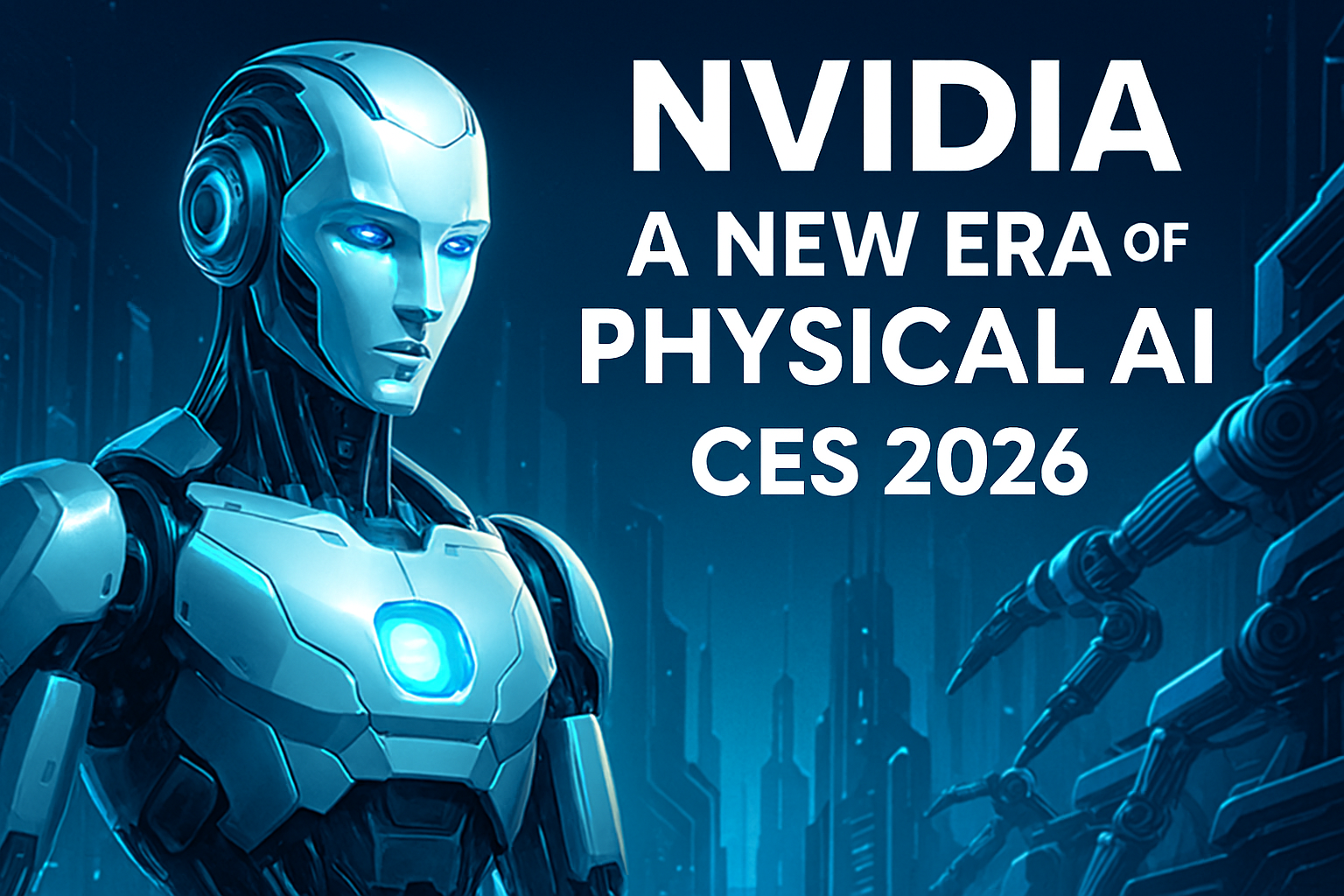
CES 2026 has officially set the tone for the technological decade ahead, and NVIDIA once again dominated the global stage. During a highly anticipated keynote in Las Vegas, CEO Jensen Huang introduced a wave of innovations centered around a concept that is reshaping the industry: Physical AI. This new direction blends advanced artificial intelligence models with real‑world robotics, enabling machines to perceive, reason, and act with unprecedented precision.
While NVIDIA has long been the leader in generative AI and accelerated computing, the company is now positioning itself to lead the next frontier—AI that interacts directly with the physical world.
🔥 Physical AI: NVIDIA’s Most Ambitious Vision Yet
According to early CES coverage, NVIDIA’s presentation focused on how AI is evolving beyond text, images, and digital data. The next phase is about embodied intelligence—robots and autonomous systems capable of learning complex tasks through simulation and then executing them in real environments.
NVIDIA showcased:
- Robots trained entirely in virtual environments before deployment
- AI models that combine vision, motion planning, and decision‑making
- Systems capable of adapting to dynamic, unpredictable conditions
- Platforms designed to accelerate industrial automation
This shift toward Physical AI represents a major leap for industries such as manufacturing, logistics, automotive, and even consumer robotics.
🧠 Smarter, Faster, and More Efficient AI Models
NVIDIA also introduced improvements across its AI ecosystem, including new hardware and software designed to support the growing demand for autonomous systems.
✔ Next‑generation GPUs for AI workloads
The company revealed new processors optimized for robotics, simulation, and generative AI. These chips promise higher efficiency, lower latency, and better performance for real‑time decision‑making.
✔ Platforms for autonomous agents
NVIDIA is expanding its suite of tools that allow developers to build intelligent agents capable of navigating complex environments, analyzing sensor data, and performing tasks with minimal human intervention.
✔ Deep integration with simulation technologies
Simulation remains a core pillar of NVIDIA’s strategy. By training robots in hyper‑realistic virtual worlds, companies can reduce costs, minimize risks, and accelerate deployment.
🤖 Robotics Takes Center Stage at CES 2026
One of the most impressive parts of the keynote was the live demonstration of advanced robots powered by NVIDIA’s latest AI models. These robots showcased natural movement, improved perception, and the ability to learn new tasks without manual programming.
Highlights included:
- Humanoid robots with smoother, more human‑like motion
- Industrial robots capable of assembling components with precision
- Service robots designed for logistics, retail, and hospitality
- Vision systems that allow robots to “understand” their surroundings
The combination of advanced hardware and AI‑driven intelligence is pushing robotics closer to mainstream adoption.
🌐 CES 2026: A Show Fully Dominated by AI
While CES has always been known for futuristic gadgets, this year’s event made one thing clear: AI is the core of every major innovation. NVIDIA’s keynote reinforced the idea that artificial intelligence is no longer a feature—it is the foundation of modern technology.
Key takeaways from the event:
- AI is driving the next wave of industrial transformation
- Robotics is entering a phase of rapid acceleration
- Simulation is becoming essential for training autonomous systems
- Companies adopting Physical AI will gain a competitive edge
NVIDIA’s announcements signal a future where AI is deeply integrated into both digital and physical environments.
📈 What This Means for the Future of Technology
The rise of Physical AI marks a turning point for the industry. Until now, AI has primarily operated in the digital realm—analyzing data, generating content, and assisting with virtual tasks. In 2026, the focus is shifting toward real‑world intelligence.
This evolution will impact:
- Manufacturing: smarter, more adaptable robots
- Transportation: safer autonomous vehicles
- Logistics: fully automated warehouses
- Healthcare: robotic assistants and precision systems
- Consumer tech: home robots capable of meaningful tasks
NVIDIA’s vision suggests that the next decade will be defined by machines that can learn, adapt, and collaborate with humans in everyday environments.
💡 Fun Fact – AI Edition
In 2025, more than 70% of new industrial robots included AI‑powered vision or motion systems. Analysts predict that by the end of 2026, that number could exceed 90%, marking the fastest adoption curve in robotics history.