
Fun Fact
Nintendo’s internal codename for its early AI‑upscaling prototypes was reportedly so vague and unassuming that third‑party studios didn’t realize what they were testing—until they saw their own games running 40–60% sharper without touching a single asset.
By: Gaming Editorial / Market Analysis
For years, the “third‑party gap” was Nintendo’s greatest stigma — a technical chasm that kept major industry releases from landing on its consoles without painful visual compromises or half‑measures like cloud versions that never fully satisfied the core fanbase. But as of January 2026, that narrative has flipped. What began as experimental deep‑learning patents in late 2024 has quietly evolved into the foundation of a next‑generation software ecosystem. Nintendo is no longer the underdog fighting hardware limitations; it’s now fluent in the same technological language as its peers, just spoken with a very different accent.
According to the latest reports from Famitsu and analysts at GamesIndustry.biz, the Switch 2 is in its acceleration phase. And it’s no longer about Mario looking crisper. It’s about 16 Triple-A titles leveraging machine learning to achieve performance parity across platforms.
The End of the “Impossible Port” and the Rise of AI Efficiency
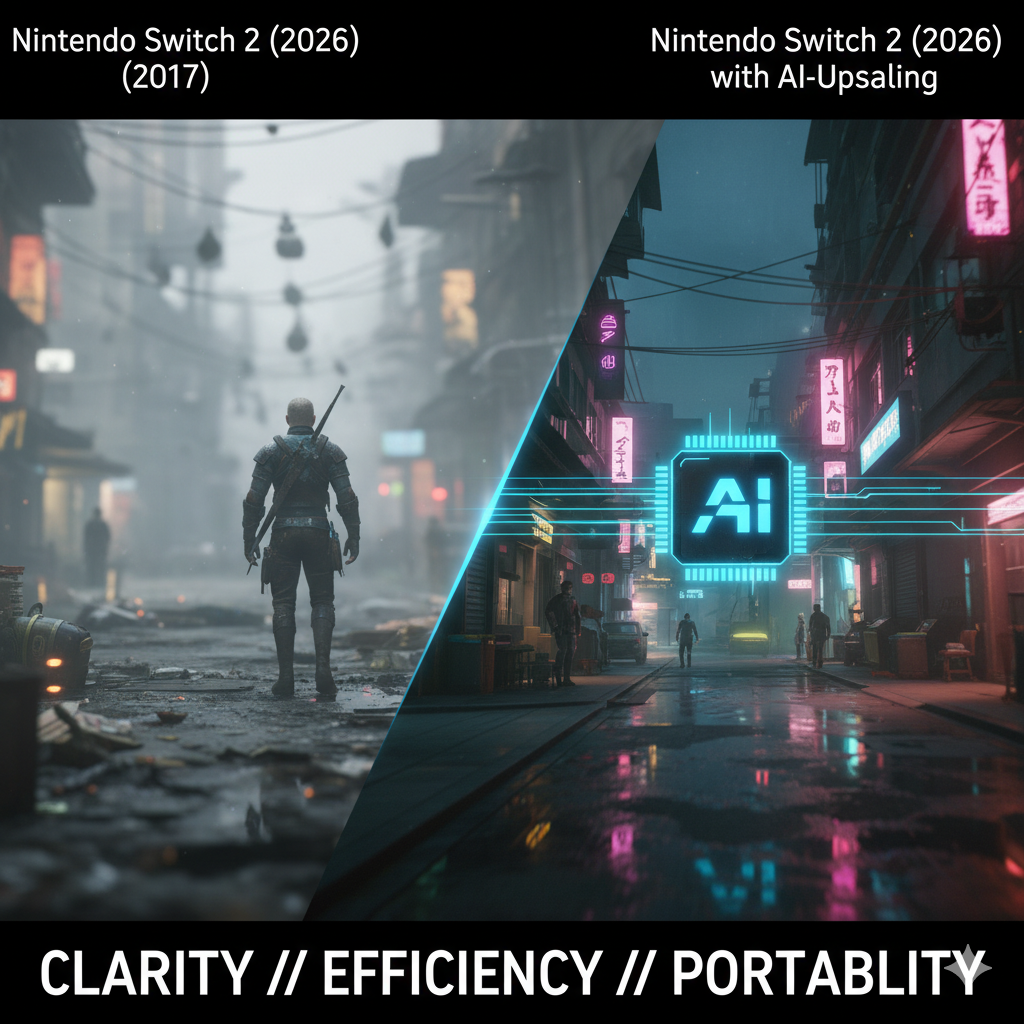
The catalyst behind this turnaround? Nintendo’s Unified Scaling Profile — an adaptive framework built around the custom NVIDIA Tegra T239 chip. Instead of developers rewriting render engines or sacrificing assets, the hardware itself now handles image reconstruction and resolution scaling via dedicated AI inference cores.
What once took months of optimization and painful trade-offs now takes weeks — and with better results. One developer close to VGC put it plainly:
“We’re no longer fighting the hardware. We’re collaborating with it.”
It’s a new era where AI isn’t just a feature — it’s a workflow liberator.
The List of 16: The Catalog Reshaping 2026
The Japanese Giants
- Monster Hunter Wilds (Capcom): Dense jungles and dynamic weather remain stable at 60fps thanks to DLSS-like AI reconstruction.
- Resident Evil 9 (Capcom): Arrives day-one with other platforms, fully optimized RE Engine v.2 support.
- Final Fantasy VII Remake Intergrade (Square Enix): Launches with higher texture fidelity, aided by fast LPDDR5X memory.
- Persona 6 (SEGA/Atlus): A global simultaneous release that positions Nintendo as a serious home for modern JRPGs.
- Elden Ring: Shadow of the Erdtree Edition (FromSoftware): Features simplified Ray Tracing effects enhanced by ML filters.
The Western Offensive
- Grand Theft Auto V: Enhanced Edition (Rockstar Games): Now with near-zero load times using internal NVMe storage.
- Star Wars Outlaws (Ubisoft): 720p base dynamically rebuilt into crisp 4K output.
- Cyberpunk 2077: Phantom Liberty (CD Projekt Red): Better than the PS4 version, thanks to dedicated upscaling hardware.
- Call of Duty: Black Ops Gulf War (Activision): Content parity on Nintendo for the first time in over a decade.
- Assassin’s Creed Shadows (Ubisoft): Gorgeous environments rendered with minimal throttling on handheld mode.
The Nintendo Core (First-Party)
- Metroid Prime 4: Beyond: Flagship graphics title for Switch 2 — a technical showpiece.
- Super Mario Odyssey 2: Features neural-enhanced fluid simulations and reactive ecosystems.
- Mario Kart X: Deep integration with cloud-sync and tournament ranking systems.
- The Legend of Zelda: Twilight Mirror: Includes destructible environments powered by new physics cores.
- Animal Crossing: New Horizons 2: Villagers now exhibit AI-driven personalities and routines.
- Pokémon Legends: Kyurem: Finally meets visual expectations with ML-assisted asset reconstruction.
Personal Perspective: From “Vaseline Vision” to True Clarity
If you’re someone who powered through Xenoblade Chronicles 2 on the go in 2017, squinting through blurry textures and unstable frame rates, you know exactly what I mean when I say “Vaseline vision.”
Back then, portable AAA gaming meant compromise.
You accepted jagged shadows, fuzzy geometry, and weird frame pacing because it was magic to have the full game at all.
But this?
This is a different game.
The Witcher 3 on the old Switch looked like a miracle — until you compared it to the PS5 version. But Cyberpunk 2077 on Switch 2? It’s just good. No mental asterisks. No “for a handheld” qualifiers. That’s the difference AI makes.
If you’re tracking how major engines adapt to AI‑native rendering, this breakdown of Unreal Engine 6’s Neural Assets explores how Epic Games is applying similar concepts to optimize next‑generation game pipelines:
https://techfusiondaily.com/unreal-engine-6-neural-assets-explained/
Conclusion: Efficiency Over Brute Force
2026 might go down as the year Nintendo stopped playing catch-up and started defining the conversation.
While Sony and Microsoft grapple with energy-hungry silicon and ballooning budgets, Nintendo found the elegant middle — not raw performance, but smart performance. These 16 games represent more than a good launch year. They are a new design philosophy in motion:
AI as amplifier. Portability without penalty. Constraints turned into creativity.
And for the first time in years, it doesn’t feel like Nintendo is trailing behind.
It feels like Nintendo is leading from a different lane — and loving it.
Additional Sources:
Digital Foundry – Nintendo Switch 2 Tech Analysis
Bloomberg Technology – Nintendo Supply Chain Reports
Originally published at https://techfusiondaily.com