
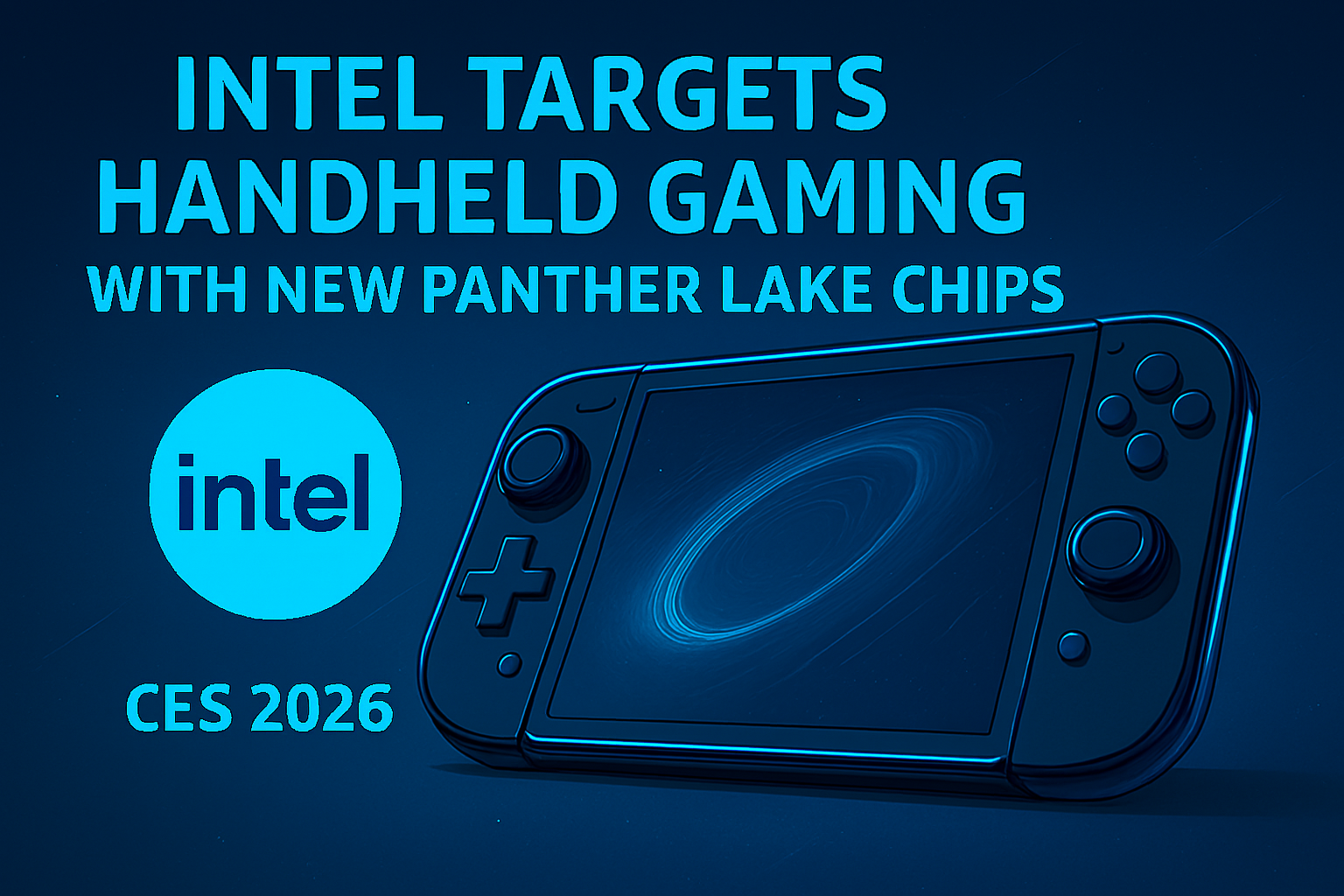
Intel made one of the most surprising gaming announcements at CES 2026, confirming that its upcoming Panther Lake processors will include a dedicated line optimized specifically for handheld gaming devices. This marks a major strategic shift for Intel, which has historically focused on desktops and laptops, leaving the handheld market almost entirely to AMD. With the explosive growth of portable gaming PCs, Intel is now positioning itself to become a serious competitor in a category that shows no signs of slowing down.
A Market Intel Can No Longer Ignore
The handheld gaming market has transformed dramatically over the past four years. What began with the Steam Deck in 2022 has evolved into a full ecosystem of portable PCs capable of running AAA games. Devices like the ASUS ROG Ally, Lenovo Legion Go, MSI Claw, and Ayaneo models have proven that gamers want powerful, PC‑level performance in a portable form factor.
Industry analysts estimate that the handheld gaming segment will grow by more than 30% annually through 2028, driven by:
- More efficient mobile processors
- AI‑enhanced upscaling technologies
- Improved cooling systems
- A massive library of PC games compatible with handhelds
- The rise of cloud gaming as a hybrid option
Intel’s move into this space is not just timely — it’s necessary. AMD’s dominance has gone unchallenged for years, and Intel sees an opportunity to disrupt the market with a new architecture built from the ground up for efficiency and performance.
Panther Lake: A New Architecture for a New Era
Intel’s Panther Lake processors introduce several key improvements designed specifically for mobile and handheld gaming. According to early reports from CES 2026, the architecture focuses on three pillars: efficiency, graphics performance, and AI acceleration.
1. Low‑Power Performance Cores
Panther Lake introduces redesigned low‑power cores that deliver higher performance per watt. This is crucial for handhelds, where battery life is often the biggest limitation.
2. Upgraded Xe2 Integrated Graphics
Intel’s new Xe2 GPU architecture promises a significant leap in integrated graphics performance. Early demos suggest that Xe2 could rival AMD’s RDNA‑based iGPUs in mid‑range handhelds.
3. AI‑Accelerated Upscaling
Intel is integrating AI‑powered upscaling similar to NVIDIA DLSS and AMD FSR. This allows handhelds to render games at lower resolutions while outputting higher‑quality visuals, improving both performance and battery life.
4. Thermal Efficiency
Panther Lake is designed to run cooler under sustained loads, addressing one of the biggest challenges in handheld gaming: heat buildup during long play sessions.
Intel vs. AMD: The Battle for Portable Gaming
AMD has dominated handheld gaming thanks to its Ryzen Z1 and Z1 Extreme chips, which power most of the top devices on the market. Intel’s challenge is to match or surpass AMD in several areas:
- Battery efficiency
- GPU performance
- Driver stability
- Heat management
- Compatibility with Windows gaming
If Intel delivers on its promises, the handheld market could see its first major shakeup since the launch of the Steam Deck.
Partnerships Already in Motion
Although Intel did not reveal specific partners at CES, industry insiders report that several OEMs are already testing Panther Lake prototypes. Companies rumored to be involved include:
- ASUS
- MSI
- Lenovo
- Ayaneo
- GPD
If these partnerships materialize, the first Intel‑powered handhelds could arrive as early as Q4 2026.
What Gamers Can Expect
Intel’s entry into handheld gaming could bring several benefits to consumers:
More Competition
More chipmakers means more innovation and better pricing.
Better Battery Life
Panther Lake’s efficiency‑focused design could extend play sessions significantly.
Improved Graphics
Xe2 integrated graphics may allow 1080p gaming on portable devices without relying on external GPUs.
AI‑Driven Enhancements
AI upscaling could become standard across all handhelds, not just premium models.
A New Wave of Devices
Expect thinner, lighter, and more powerful handhelds in 2026 and 2027.
Release Window
Intel confirmed that Panther Lake will debut in late 2026, with handheld‑optimized variants expected shortly after the desktop and laptop versions. Developers will receive early access kits in mid‑2026.
Conclusion
Intel’s move into handheld gaming marks a turning point for the industry. With Panther Lake, the company is betting big on portable gaming as the next frontier of PC hardware. If Intel delivers on its promises, 2026 could be the year handheld gaming becomes more competitive — and more exciting — than ever before.
Fun Fact
The first handheld PC capable of running full Windows launched in 2016 — a decade before the handheld gaming boom.