

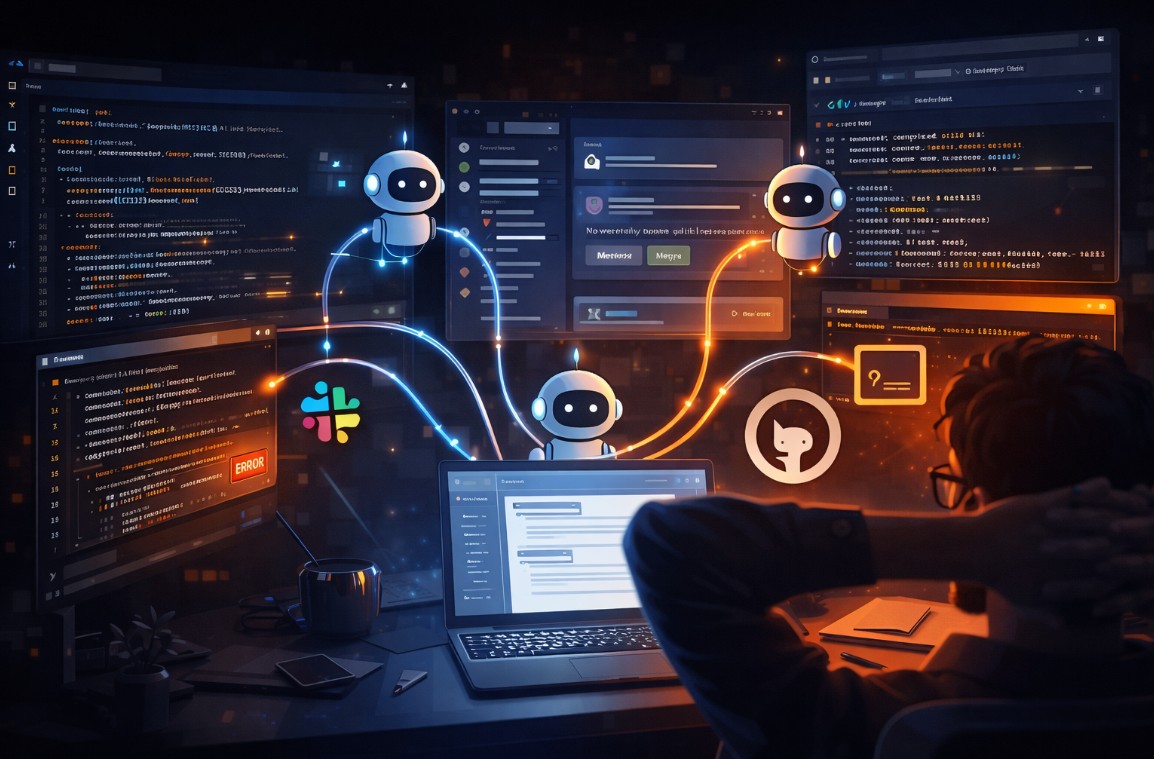
Fun Fact: The average software engineer spends roughly 35% of their workday not writing code — reviewing it, triaging alerts, waiting on pipelines, and responding to incidents. Cursor just bet that number is the real product opportunity.
Cursor Automations is the most significant shift in AI-assisted development since GitHub Copilot taught developers to stop typing boilerplate — and it’s solving a completely different problem.
The new system doesn’t help you write code faster. It removes the part where you have to be there at all.
What Cursor Automations Actually Does
The core idea is deceptively simple: instead of waiting for a developer to open the editor and start a prompt, Cursor now lets AI agents trigger automatically — based on changes in the codebase, incoming Slack messages, scheduled timers, or incident alerts.
A pull request opens. An agent reviews it. A monitoring alert fires. An agent investigates, traces the origin, and drafts a fix. A Slack message flags a bug. An agent starts working on it before the engineer finishes their coffee.
This isn’t autocomplete. This isn’t a smarter IDE. This is a background worker that runs on your codebase while you’re doing something else — and that distinction matters more than any benchmark comparison.
The Attention Bottleneck Problem
What makes Cursor Automations structurally interesting is the assumption underneath it. The company’s bet isn’t that AI models need to get smarter — it’s that human attention is the actual bottleneck.
An experienced engineer can supervise maybe two or three AI agents working in parallel before things start slipping through. Context switches cost time. Alerts pile up. Review queues grow. The problem isn’t capability, it’s throughput — and no amount of better code generation solves a throughput problem.
Automations are designed to work in the background without requiring constant prompting or monitoring. The agent handles the trigger, runs the task, and surfaces the result. The engineer reviews the output instead of doing the work from scratch.
That’s a fundamentally different workflow than anything that existed two years ago — and it’s the direction the entire AI coding category is moving.
If you’re following how Meta’s ecosystem is evolving beyond software updates, this deep dive into Why AI Hardware — Not Models — Will Decide the Next Tech Cycle provides essential context for understanding the company’s broader hardware and platform strategy:
https://techfusiondaily.com/why-ai-hardware-not-models-next-tech-cycle-2026/

Why This Is a Bigger Deal Than It Looks
The AI coding race has been framed almost entirely around model quality. Who has the best autocomplete. Whose suggestions are more accurate. Which tool catches more bugs in real time. That framing made sense when the primary use case was helping a developer write code faster.
Cursor Automations reframes the competition entirely. The question is no longer which tool makes you faster — it’s which tool keeps working when you’re not watching. Orchestration, workflow design, and trust around autonomous agent behavior become the new battleground.
GitHub and JetBrains both have AI coding assistants with significant market share. Neither has shipped anything that operates this autonomously at the workflow level. That gap won’t last long — but Cursor is currently defining what the category looks like when it grows up.
The Trust Problem Nobody Is Talking About
Autonomous agents touching production codebases without direct human prompting is not a small thing. The value proposition requires trusting that the agent won’t make a change that’s subtly wrong, won’t misread the context of an incident, won’t introduce a fix that creates a new problem downstream.
That trust has to be earned incrementally — through audit trails, clear scope boundaries, and the kind of track record that only comes from real-world deployment at scale. Cursor knows this. The Automations launch is conservative by design: triggers are explicit, outputs are surfaced for review, and the system isn’t making autonomous commits without human sign-off.
But the direction is clear. Every iteration moves closer to agents that operate with less supervision. The teams that start building workflows around Cursor Automations now will have a meaningful advantage when that autonomy expands — and the teams that wait will be catching up.
The companies that figure out how to supervise agents at scale — not just deploy them — are going to win the next phase of the software productivity race. That problem is harder than it sounds, and it isn’t solved yet.
Sources
TechCrunch — Cursor Automations launch coverage, March 2026
Cursor official product announcement, March 2026
Originally published at TechFusionDaily by Nelson Contreras
https://techfusiondaily.com