

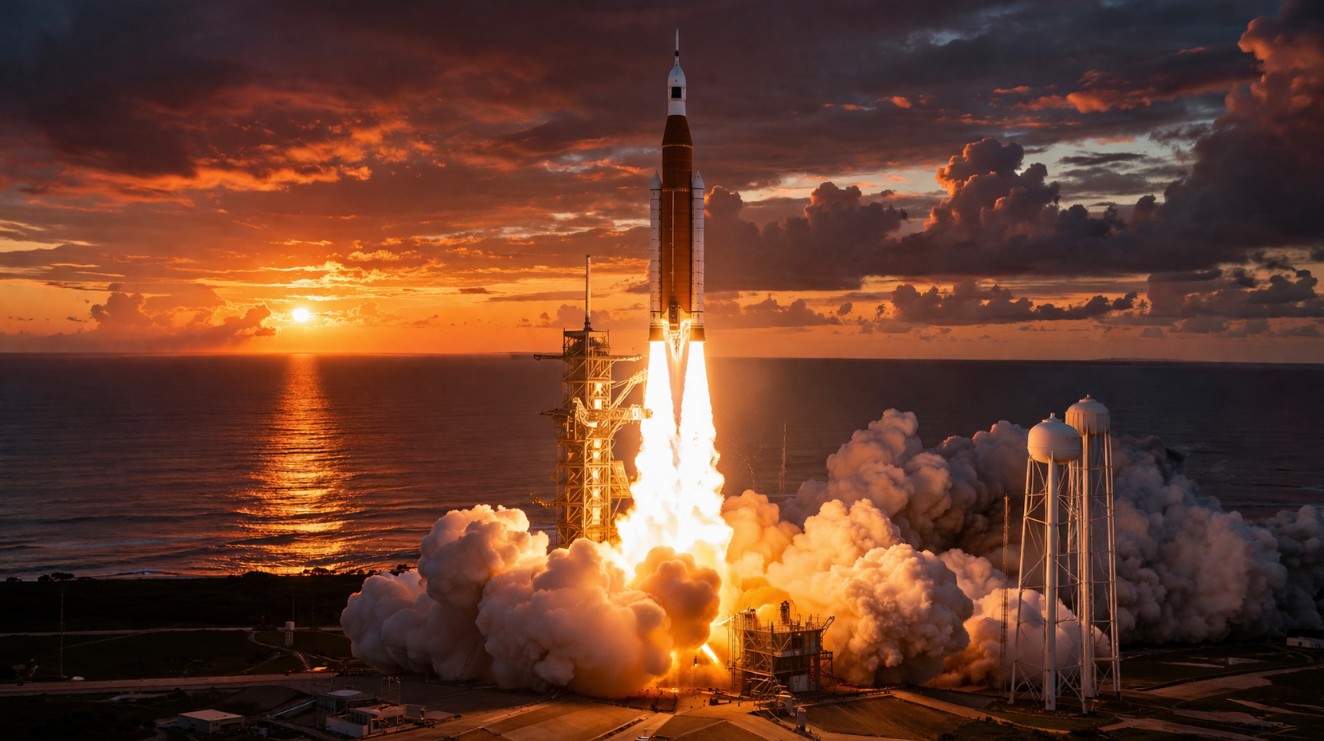
Fun Fact: Apollo 13 never made it to the Moon — it aborted after an oxygen tank exploded. But its emergency free-return trajectory accidentally sent the crew farther from Earth than any other Apollo mission. Artemis II is about to beat that distance record on purpose.
The Artemis II mission launched April 1 at 6:35 p.m. ET from Kennedy Space Center — and four astronauts are currently en route to the Moon for the first time since Apollo 17 in 1972. That’s 53 years. Two generations of engineers, policy pivots, budget cuts, and canceled programs stand between the last time humans went this far and right now. Commander Reid Wiseman, Pilot Victor Glover, Mission Specialist Christina Koch, and Canadian Space Agency astronaut Jeremy Hansen are already three days into a 10-day mission that will take Orion around the Moon’s far side and back to Earth for splashdown off San Diego.
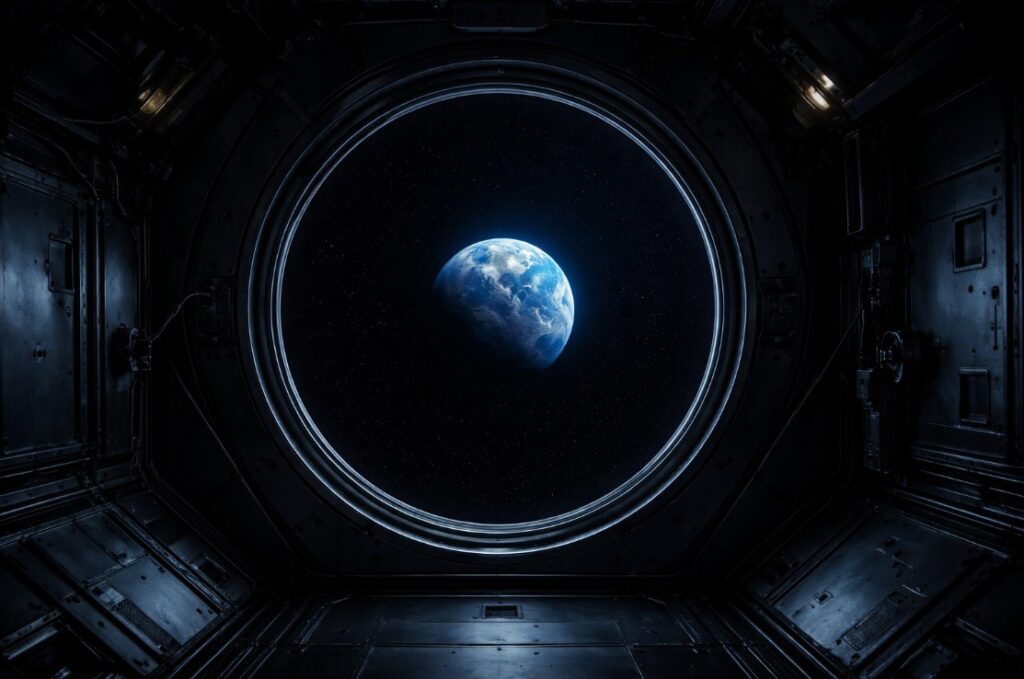
This morning, Wiseman shared photos of Earth through Orion’s window. The distance is already enough to see the entire globe — Africa, Europe, the northern lights — in a single frame. That image, more than any press release, captures what the Artemis II mission actually is.
What This Mission Is Actually Testing
Artemis II is not a landing mission. The crew won’t set foot on the Moon — that’s Artemis III, currently targeting 2028. What this mission does is something arguably more important: it’s the first time NASA has put humans inside the Orion spacecraft in deep space to test whether it actually works as designed.
Life support systems, navigation, manual maneuvering capabilities, radiation exposure at lunar distances, medical equipment in zero gravity — all of it getting stress-tested with real crew aboard, not simulations. On Day 3 the crew practiced CPR in zero gravity and demoed onboard medical systems. That’s not a dramatic headline, but it’s the kind of operational data that will determine whether Artemis III is safe to attempt at all.
The translunar injection burn happened April 2 — a 5 minute, 55 second engine firing that sent Orion beyond Earth orbit for the first time with humans aboard since 1972. Mission Control confirmed: clean burn, nominal trajectory.
To better understand the infrastructure and strategic pressures shaping the AI arms race, this deep dive into Why Most People Are Using ChatGPT Wrong — And the Gap Is Getting Wider explores why capital, compute, and control are becoming inseparable in next-generation AI development:
https://techfusiondaily.com/prompt-engineering-using-chatgpt-wrong/
The Record That Nobody Expected
Here’s the number worth paying attention to: the Artemis II mission is expected to reach a maximum distance of approximately 252,021 miles from Earth. Apollo 13 — the mission that famously didn’t make it to the Moon after an oxygen tank exploded — holds the current record at 248,655 miles, a distance it reached accidentally during its emergency return trajectory.
Artemis II will beat that record on purpose, as part of a planned free-return trajectory designed to bring the crew around the Moon’s far side and back without requiring an additional engine burn. The crew will temporarily lose contact with Earth when Orion passes behind the Moon — a brief, scheduled communications blackout that mirrors what Apollo crews experienced half a century ago.
The lunar flyby is set for April 6. At that point, Artemis II becomes the closest humans have been to another world since December 1972.
Why This Matters Beyond the Headlines
The Artemis II mission is a test flight. But what it’s really testing is whether the entire architecture NASA and its partners have spent the last decade building — the Space Launch System, the Orion spacecraft, the ground systems at Kennedy Space Center — can support sustained human presence beyond Earth orbit.
SpaceX is developing Starship as the eventual lunar lander for Artemis III. The Canadian Space Agency is a full mission partner, with Jeremy Hansen becoming the first Canadian to reach deep space. The mission is also running AVATAR — organ-on-a-chip experiments studying how radiation and microgravity affect human tissue, with direct implications for long-duration Mars missions.
None of this is routine. The communications glitch that briefly prevented Mission Control from hearing the crew’s responses 51 minutes after launch — resolved quickly, but real — is a reminder that operating at lunar distances introduces failure modes that ground testing simply can’t replicate. Every anomaly caught on Artemis II is one that won’t kill someone on Artemis III.
The Longer Game
The Moon flyby on April 6 will generate the kind of imagery that tends to briefly unite people across everything that divides them. NASA is streaming it live. It will be the first time cameras have captured the view from this distance with humans in frame since Apollo.
But the more consequential moment is the splashdown — expected around April 10 off the coast of San Diego. If Orion’s heat shield performs, if the parachutes deploy, if the crew comes home healthy, then the question of whether humans can safely operate at lunar distances in 2026 gets answered. And the next question — whether we can actually land on the Moon in 2028 — becomes the one everyone starts asking.
Fifty-three years is a long time to wait. The crew is already halfway there.
Sources
NASA — Artemis II official mission updates and launch day blog, April 1–3, 2026
Space.com — Artemis II live mission coverage, April 3, 2026
Originally published at TechFusionDaily by Nelson Contreras
https://techfusiondaily.com