
Fun Fact:
The last time China used a Five-Year Plan to dominate a hardware sector, the world spent a decade calling it “subsidized junk.” Then it captured 85% of global solar panel production. Nobody called it junk after that.
China humanoid robots are no longer a research priority — China’s National People’s Congress opened this week with an agenda that reads less like a policy document and more like a declaration of industrial intent.
The 15th Five-Year Plan for 2026–2030 puts China’s humanoid robotics strategy — what Beijing calls “embodied intelligence” — front and center. For anyone paying attention to where the next wave of physical AI is heading, the signal is hard to ignore.
This isn’t Beijing announcing research priorities. It’s Beijing announcing which industries it plans to own.
No Stage. Just a Signal.
Before the Parliament even opened, China sent a message. At the CCTV Spring Festival Gala — the most-watched TV broadcast on the planet — Chinese-made humanoid robots performed dancing and martial arts routines in front of hundreds of millions of viewers.
It wasn’t a tech demo buried in a conference hall. It was prime time, choreographed national theater. Governments don’t put unproven technology on their most visible cultural stage unless they’re confident it’s ready — or at least ready enough to look ready. That distinction matters more than the performance itself.
What the Five-Year Plan Actually Says
The NPC roadmap signals aggressive policy support for embodied intelligence — the hardware and software stack that powers humanoid robots. AI models get a mention. Robotics gets the headline.
Mechatronics — balance, motor control, dynamic locomotion — has improved dramatically over the past 12 months, according to analysts working directly with leading Chinese robotics firms. That’s not marketing language. That’s engineers confirming the hardware gap is closing faster than most Western observers expected.
China invested over $20 billion in AI in Q4 2025 alone. Now that capital is flowing into the physical layer — the robots, the actuators, the supply chains that turn AI software into machines that can move through the world.
To better understand the infrastructure and strategic pressures shaping the AI arms race, this deep dive into Why Most People Are Using ChatGPT Wrong — And the Gap Is Getting Wider explores why capital, compute, and control are becoming inseparable in next-generation AI development:
https://techfusiondaily.com/prompt-engineering-using-chatgpt-wrong/
The Consolidation Problem Nobody Is Talking About
Here’s the uncomfortable detail buried inside the optimism. Chinese regulators are already warning about low differentiation among more than 150 domestic humanoid robot developers. Analysts expect consolidation to arrive faster than it did in electric vehicles — and that’s saying something.
What survives that shakeout will be formidable. What doesn’t will be acquired or absorbed into state-backed champions. Either way, the West is not the primary competitor in that race.
Manufacturing, Not Demos
Western coverage of Chinese robotics tends to focus on the spectacle — robots dancing, robots doing backflips, robots looking almost human enough to be unsettling. That framing misses the point almost entirely.
China humanoid robots represent Beijing’s push to move up the value chain in advanced manufacturing. The endgame isn’t a robot that can entertain. It’s a robot that can build things — cars, chips, infrastructure — at a cost structure that changes the economics of global production. If that works, the competitive implications extend far beyond any single product category. They touch every industry that currently relies on human labor at scale.
What People Actually Think About All This
Beijing’s roadmap assumes the technology will arrive on schedule. What it doesn’t fully account for is whether people will accept it.
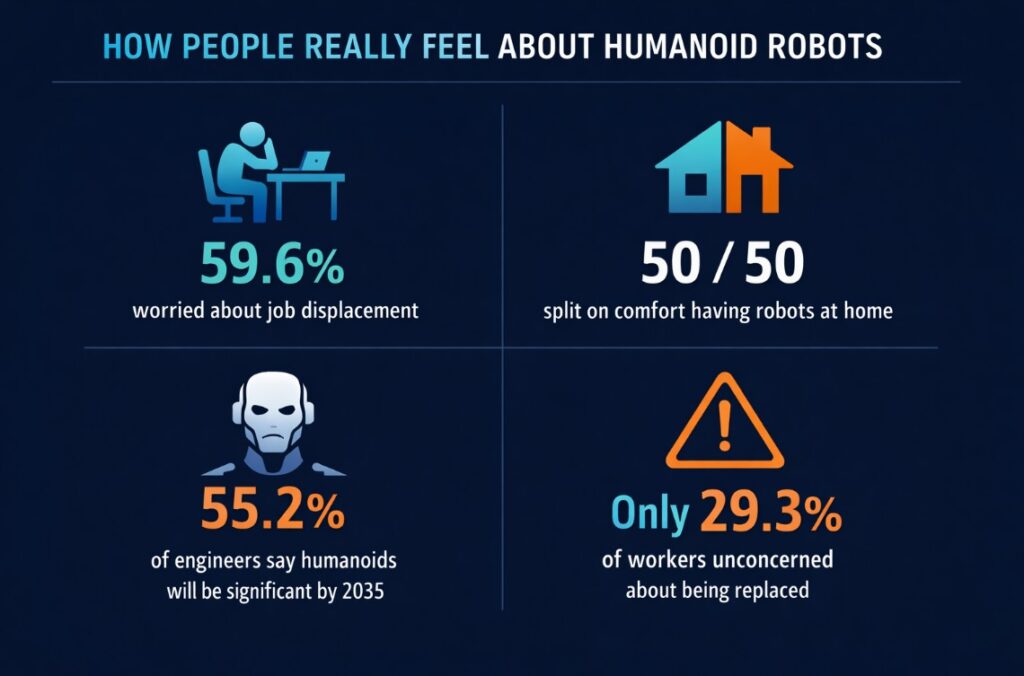
The numbers tell a complicated story. A survey of robotics engineers found that 59.6% cite job displacement as their primary concern — nearly tied with accountability for errors at 59.1%. Goldman Sachs estimates automation could impact up to 300 million jobs globally, and the people building these machines aren’t dismissing that number.
On the consumer side, a recent Altman Solon survey found a 50/50 split on comfort levels around having a human-sized robot at home. The primary fears aren’t science fiction — they’re practical: physical danger and intimidation. Meanwhile, 55.2% of engineers believe humanoids will become extremely significant within a decade, but the affordable, safe version consumers actually want has yet to arrive.
The technology may be ready before the trust is. And trust, unlike hardware, cannot be manufactured at scale.
The Limits Nobody Wants to Admit
Beijing’s own economists are being honest about the constraints. Rhodium Group warns that China’s emerging industries won’t generate sufficient investment to sustain 5% GDP growth in the coming years. The humanoid robotics push is a long bet, not an immediate economic solution.
But long bets with state-level resources behind them have a way of arriving ahead of schedule — especially when the rest of the world is still debating whether to take them seriously.
The Question Worth Asking Now
The solar panel story took a decade to fully land. The EV story took slightly less. Humanoid robotics, with AI accelerating every layer of the stack, may move faster than either.
If China’s Five-Year Plan delivers even half of what it’s signaling — who exactly is building the Western alternative, and on what timeline?
Sources
Reuters — Eduardo Baptista and Laurie Chen
Studio Red — 2025 Robotics Industry Survey
Originally published at https://techfusiondaily.com