
Fun Fact:
The last time Nvidia had a revenue spike this violent,
it wasn’t because of AI — it was the crypto mining boom of 2017.
The company spent years publicly downplaying it. Then the crash came,
inventory piled up, and nobody wanted to talk about it at all.
Nvidia’s latest earnings confirm something that’s been floating under
the surface for months. The AI boom has quietly shifted from a model
race to an infrastructure arms race.
Nvidia AI infrastructure is not marketing language anymore — it’s
a structural reality. And the company’s numbers are blunt enough to
cut through the hype.
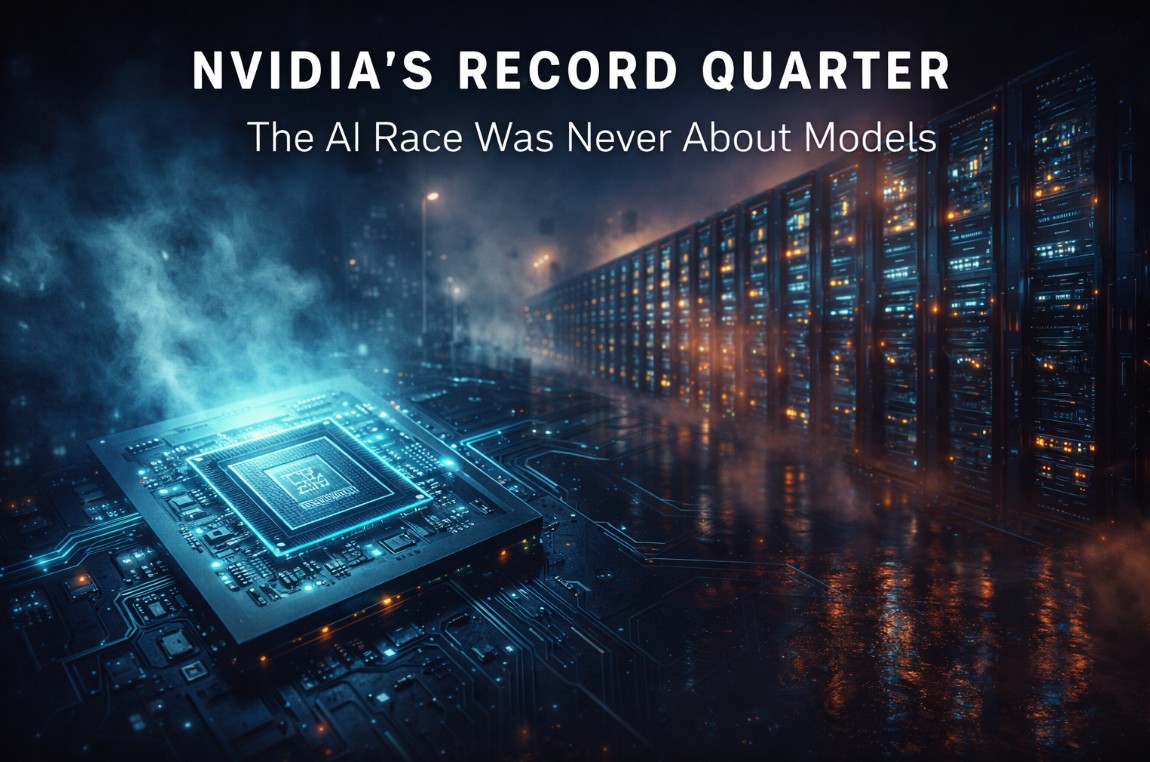
Nvidia reported $68.1 billion in quarterly revenue, with
$62.3 billion coming from data centers. That’s a
75% year-over-year jump. Not incremental growth. That’s demand
overwhelming supply while the rest of the industry is still debating
benchmark leaderboards.
Physics has entered the chat.
The Quarter That Broke the Narrative
For years, the AI story was framed around model releases — GPT-4,
Gemini, Claude, Llama. Benchmarks dominated headlines. Parameter
counts became a proxy for ambition, and leaderboards gave journalists
something easy to summarize.
Nvidia’s earnings call quietly flipped that hierarchy. The real
competition is happening inside data centers, not research labs.
Hyperscalers are buying GPUs in volumes that would’ve sounded
reckless two years ago. Enterprises that once debated “AI strategy
decks” are now signing multi-year infrastructure commitments. Even
governments are negotiating compute allocations like they’re securing
oil reserves.
Nvidia didn’t just beat estimates. It revealed how structurally
dependent the entire ecosystem has become on a single hardware layer.
Jensen Huang didn’t soften the framing either. He described the
moment as a platform transition — the kind that doesn’t reverse just
because enthusiasm cools or a new model disappoints. That’s a very
different story from “AI hype cycle.”
The Uncomfortable Economics of AI Infrastructure
There’s a reason Nvidia AI infrastructure is the new center of
gravity: it’s the one layer that cannot be simulated or open-sourced
away.
You can fork a model. You can optimize a benchmark. You can tweak a
roadmap. What you cannot do is improvise a 500-megawatt power
footprint on short notice.
The economics are starting to resemble early industrial consolidation.
Whoever controls the machinery controls the margin — except the
machinery now is silicon wafers, liquid cooling systems, and
electrical substations that take years to permit and build.
Three pressure points are becoming impossible to ignore. Energy: AI
clusters are drawing enough power to trigger regulatory conversations
that didn’t exist three years ago. Capital expenditure: hyperscalers
are spending at a rate that makes even seasoned investors uneasy.
And latency: physical proximity matters again — compute wants to live
near users and data, not on the other side of a continent.
This is not the version of AI that looked clean in research papers.
This is industrial infrastructure with geopolitical implications, and
industrial systems do not scale frictionlessly.
To better understand how long-term infrastructure bets are reshaping modern technology platforms, this deep dive into Why Most People Are Using ChatGPT Wrong — And the Gap Is Getting Wider explores why scale, energy, and timing are becoming decisive factors in the future of computing:
https://techfusiondaily.com/prompt-engineering-using-chatgpt-wrong/

The Geopolitical Layer Nobody Wants to Talk About
When Nvidia’s data center revenue jumps 75% in a single year, it
stops being a quarterly headline and starts becoming a national
strategy variable.
AI capability now maps directly to access — access to advanced chips,
stable energy supply, capital, and resilient supply chains. The U.S.
is tightening export controls. China is accelerating domestic
accelerator development. Europe is quietly trying not to become a
permanent compute importer. India is negotiating alliances to stay
relevant in the stack.
Nvidia sits uncomfortably in the middle of all of it. Not because it
publishes the best models — but because it manufactures the hardware
layer every serious model depends on. That distinction matters more
every quarter this growth continues.
The Hidden Risk: Scaling Faster Than the Foundations
There’s a recurring pattern in tech. When growth outpaces physical
infrastructure, something eventually cracks — and it rarely cracks
where anyone was watching.
Broadband rollouts hit bottlenecks in the early 2000s. Cloud adoption
stressed data center capacity through the 2010s. Crypto mining exposed
energy fragility in 2017. Now AI is simultaneously testing power
grids, cooling systems, land zoning constraints, semiconductor supply
chains, and the political tolerance of governments that didn’t sign up
to become compute regulators.
Everyone is operating as if exponential demand can be matched
smoothly. It can’t. Physical systems expand in steps — they require
permits, transformers, rare materials, and trained labor that
optimism cannot accelerate.
The industry is sprinting forward while the foundations are still
being poured. That mismatch doesn’t resolve with better press
releases. It resolves with hard engineering decisions and
uncomfortable policy conversations that nobody wants to have during
a bull market.
Nvidia Is No Longer “Just” a Chip Company
This quarter makes one thing structurally clear. Nvidia has evolved
from semiconductor vendor to systemic dependency.
Its revenue now functions as a proxy for the global AI build-out. Its
production constraints ripple through startup roadmaps and national
industrial plans alike. Its pricing power influences decisions being
made in boardrooms and ministries simultaneously.
That’s not a normal supplier relationship — and here’s the part
executives rarely say publicly: the companies building the most
advanced AI models are increasingly dependent on a single hardware
provider whose growth is outpacing theirs. Dependence creates
leverage. Leverage reshapes ecosystems. And concentrated leverage in
a critical infrastructure layer has historically not ended quietly.
The Question Nobody Wants to Answer
If Nvidia controls the infrastructure layer of AI — the only layer
that cannot be open-sourced, forked, or virtualized away — what
happens when the rest of the industry realizes the real competition
is no longer model vs. model, but capital vs. physics… and one
company is already miles ahead on both?
Sources
Nvidia — official financial results
Company investor materials
Originally published at https://techfusiondaily.com