


Fun Fact: More than 40% of Android’s biggest “official features” were first discovered by developers who weren’t even looking for them. They were just fixing bugs… and stumbled into something Google hadn’t planned to reveal yet.
Android 15 is still months away from launch, but early developer builds are already leaking some wild clues. And this time, it wasn’t a famous leaker or a polished report.
It was just a developer trying to fix a crashing build.
While digging through system logs, they noticed something strange: repeated references to an internal module called “Adaptive Mode Engine.” At first, the name sounds boring. Almost generic. But once you look at the surrounding flags and system calls… it becomes clear this could be one of the biggest silent upgrades Android has ever made.
We’re talking about a system-level “brain” that could allow Android to adjust itself in real time — based on what you’re doing, where you are, how your phone is moving, and what apps are running.
Here’s what we know so far.
A Hidden Intelligence Layer Inside Android
From the logs, the Adaptive Mode Engine appears to be a system-wide framework that constantly monitors:
- User behavior
- Sensor data
- App activity
- Device state
Instead of relying on static performance settings, Android 15 could shift toward fully dynamic behavior — adjusting performance, battery usage, and even UI behavior automatically.
Some of the logged features include:
- Contextual optimization
- Dynamic scene profiles
- Adaptive performance scaling
- Sensor-driven triggers
- AI-assisted resource allocation
This isn’t just another “battery saver” update. It looks like a deep architectural change that touches multiple layers of the operating system.
Why Google Suddenly Needs This
Smartphone hardware is changing fast.
Qualcomm, Samsung, and MediaTek are all building chips designed for on-device AI. NPUs are becoming just as important as CPUs and GPUs. Static system behavior simply isn’t enough anymore.
To make local AI run smoothly, Android needs:
- Ultra-fast coordination between CPU, GPU, and NPU
- Real-time performance management
- Low-latency AI inference
- Stable thermal control
- Smarter power distribution
The Adaptive Mode Engine looks like Google’s solution to this problem.
The Most Interesting Clue: “Dynamic Scene Profiles”
This part is huge.
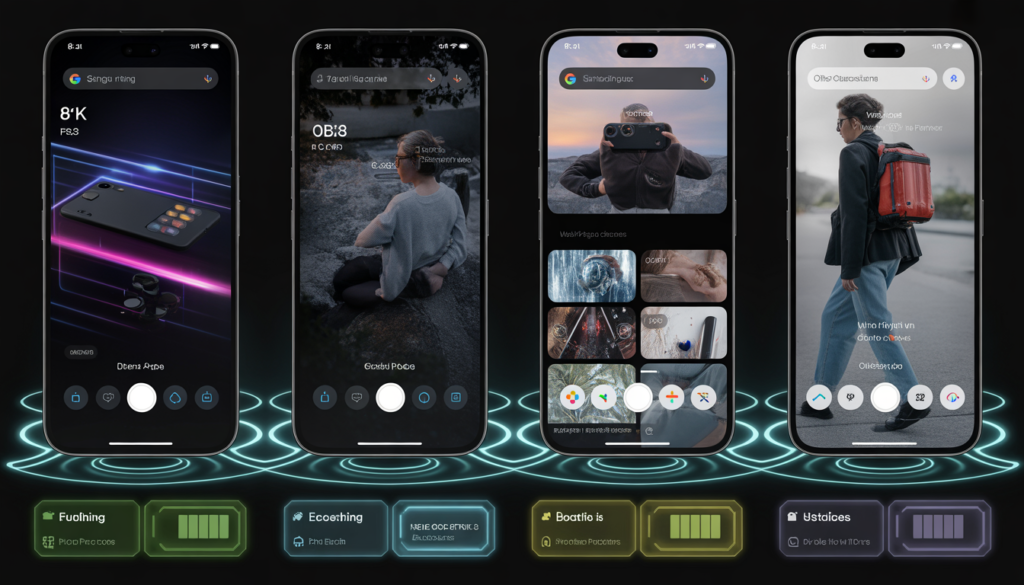
The logs reference something called dynamic scene profiles, which suggests Android could automatically detect what “mode” you’re in and adapt instantly.
For example:
- Gaming
- Photography
- Heavy multitasking
- Low-light environments
- Walking, driving, or running
- Running local AI models
Imagine your phone noticing you’re switching apps rapidly and boosting memory bandwidth. Or detecting outdoor lighting conditions and adjusting sensors to save power. Or recognizing you’re gaming and reallocating GPU resources automatically.
You don’t touch a setting. The phone just adapts.
Think of it like a silent co-pilot running inside your operating system.
For a broader look at how AI-driven systems are reshaping virtual economies, this breakdown of GTA 6’s Dynamic Economy: Black Markets, Banks & AI Explained shows how game design is starting to mirror real-world financial complexity:
https://techfusiondaily.com/gta-6-dynamic-economy/
AI Deciding How Your Phone Uses Power
Another group of flags suggests machine learning models will make performance decisions directly inside Android.
Things like:
- When to boost CPU cores
- When to throttle background apps
- When to prioritize GPU workloads
- When to reduce refresh rate
- When to shift power toward the NPU
For phones running local AI models, this could massively improve efficiency and responsiveness.
A New Permission System for “Smart” Apps
The logs also mention a new permission group tied to contextual optimization.
This could allow apps to request temporary performance adjustments, such as:
- Video editors requesting extra GPU time
- Games asking for higher thermal limits
- AI apps requesting NPU bandwidth
- Camera apps triggering low-light optimization modes
Developers get more control — without forcing users to manually tweak system settings.
Manufacturers Could Customize It
If Google allows OEM customization, this could become a new competitive battlefield.
For example:
- Samsung optimizing for extreme multitasking
- OnePlus focusing on gaming performance
- Pixel prioritizing AI features
- Xiaomi pushing aggressive battery efficiency
Just like camera pipelines became a major differentiator over the last decade, system intelligence could be next.
The Gemini Connection
Google has been heavily promoting Gemini Nano as the core of Android’s on-device AI strategy. But running AI locally isn’t just about the model — it’s about resource management.
The Adaptive Mode Engine could be the missing piece that decides:
- When AI models should run
- How much power they receive
- When to offload tasks
- How to balance performance and heat
It’s not flashy marketing material… but it’s absolutely critical.
Why The Messy Logs Make This Feel Legit
The developer who found this said the logs were chaotic:
- Duplicate entries
- Missing brackets
- Inconsistent naming
- Half-implemented modules
- Broken references
Ironically, that’s exactly what early Android features usually look like before Google cleans them up for public previews.
The mess actually makes it feel real.
What This Means For You
If this ships with Android 15, users could experience:
- Smoother multitasking
- Better battery life
- Faster AI responses
- More stable gaming
- Fewer slowdowns under heavy load
You might never see a marketing banner about it — but you’ll feel the difference every day.
What This Means For Developers
New APIs. Performance hints. Scene-based triggers. Context-aware optimization.
Apps could become faster, smarter, and more responsive without brute-force hardware upgrades.
What This Means For Google
This is bigger than a feature update.
Android is shifting from static system behavior to adaptive intelligence. AI-native devices need operating systems that react in real time. The Adaptive Mode Engine could become the foundation for Android’s next decade.
My Take
If this engine makes it into Android 15, it won’t change Android with flashy visuals or marketing buzzwords.
It will change it quietly.
Your phone will feel smoother. Smarter. More responsive. Almost like it understands what you’re doing without you telling it anything.
And that raises an interesting question:
Would you trust your phone to make these decisions for you?
Or would you want full manual control?
Either way, this might be the first step toward an Android that doesn’t just run apps — but actively thinks alongside you.
Sources
- Android 15 developer build logs
- Early tester reports
- Internal module references from preview branches
What do you think? Would you want this enabled by default — or kept optional? Drop your thoughts below 👇
Originally published at https://techfusiondaily.com