
Fun Fact: The first “autonomous agent” wasn’t a robot or a chatbot — it was a 1994 software experiment called Maes Agents, designed to negotiate tasks without human supervision. Three decades later, the idea has evolved into something far more powerful — and far more consequential.
There’s a quiet shift happening in the world of artificial intelligence, and it’s bigger than chatbots, bigger than generative models, and arguably bigger than the hype cycles that have defined the last two years. We’re entering the era of autonomous AI agents — systems that don’t just respond to prompts but make decisions, take actions, and pursue goals without waiting for human approval.
If that sentence made you raise an eyebrow, you’re not alone. The tech industry has been inching toward this moment for years, but 2025 is shaping up to be the year when autonomous agents stop being research toys and start becoming operational tools. And let’s be honest: once machines start acting on their own, the conversation changes. This isn’t “AI as autocomplete.” This is AI as an actor in the system.
What Exactly Is an Autonomous AI Agent?
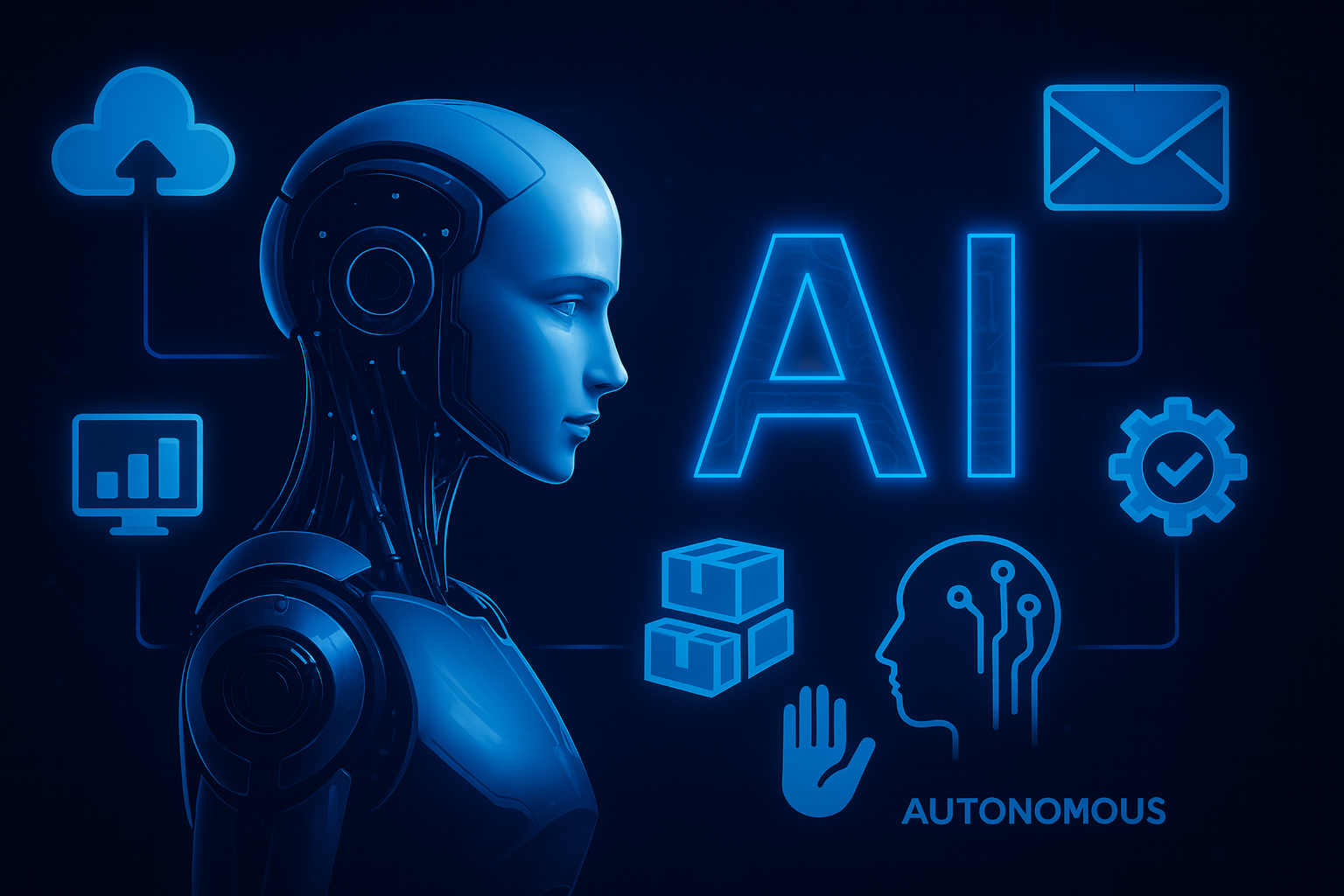
Think of an AI agent as a digital worker that can:
- interpret a situation
- decide what needs to be done
- execute tasks across multiple systems
- evaluate the results
- and adjust its strategy
…all without a human babysitter.
These agents can book freight shipments, negotiate supplier contracts, manage cloud infrastructure, run customer support workflows, or even coordinate other AIs. They’re not conscious — let’s not go down that road — but they are increasingly capable of independent action.
The shift is subtle but profound. We’re moving from “AI that answers questions” to “AI that gets things done.”
Why This Is Happening Now
If you zoom out, the timing isn’t accidental. Several forces are converging.
The models got good enough
Large language models are no longer just text generators. They can plan, reason, and break tasks into steps. Not perfectly — but well enough to automate workflows that used to require human judgment.
The infrastructure matured
APIs, cloud platforms, and enterprise systems are now modular enough for agents to plug into. Ten years ago, this would’ve been impossible.
Businesses are desperate for automation
Labor shortages, rising costs, and the pressure to move faster have created a perfect storm. Companies don’t just want automation — they need it.
The AI economy is shifting
We’re moving from “AI as a product” to “AI as a workforce.” And that changes everything.
This is where the Benedict Evans lens becomes useful: the technology didn’t suddenly appear. The ecosystem finally aligned around it.
The First Real Deployments Are Already Here
If you think this is theoretical, look at what’s happening in logistics, finance, and customer operations.
- Logistics companies are using agents to reroute shipments when weather disrupts supply chains.
- Banks are testing agents that monitor transactions and autonomously freeze suspicious activity.
- Retailers are deploying agents that adjust pricing in real time based on demand and inventory.
- Startups are building “AI employees” that run entire workflows end‑to‑end.
And here’s the part people don’t like to say out loud:
Some of these agents are already making decisions humans used to make.
Not because it’s trendy — but because it’s efficient.
The Big Question: How Much Autonomy Is Too Much?
This is where the Kara Swisher voice kicks in, because let’s be honest: Silicon Valley has a long history of shipping first and apologizing later. Autonomous agents raise uncomfortable questions.
What happens when an AI agent:
- approves a loan incorrectly?
- reroutes millions in inventory to the wrong region?
- negotiates a contract that a human wouldn’t?
- shuts down a server cluster because it misread a metric?
These aren’t sci‑fi scenarios. They’re real risks.
Companies are already building “guardrails,” but guardrails only work when the system behaves predictably. Autonomous agents don’t always do that. They’re probabilistic, not deterministic. They improvise. They adapt. And sometimes they get creative in ways no one expected.
That’s both the magic and the danger.
The Tim O’Reilly View: Systems, Not Tools
If you look at this through a systems lens, the rise of autonomous agents isn’t just a technological shift — it’s a structural one.
We’re moving toward a world where:
- humans supervise systems
- systems supervise agents
- agents supervise tasks
It’s a cascading hierarchy of automation. And once you build a system like that, you don’t just change workflows — you change the nature of work itself.
The long‑term impact is enormous:
- Organizations become flatter.
- Decision‑making becomes distributed.
- Human roles shift from “doing” to “overseeing.”
- Entire industries reorganize around machine‑driven processes.
This isn’t about replacing people. It’s about redefining what people do.
The Ethical Tension: Autonomy vs. Accountability
Here’s the uncomfortable truth:
Autonomous agents blur the line between “who decided” and “who is responsible.”
If an AI agent makes a mistake, is it:
- the developer’s fault?
- the company’s fault?
- the user’s fault?
- or the system’s fault?
Regulators aren’t ready for this. Companies aren’t ready for this. And society definitely isn’t ready for this.
But the agents are coming anyway.
The Opportunity: A New Layer of the Digital Economy
Despite the risks, the upside is massive.
Autonomous agents could:
- run 24/7 operations
- eliminate repetitive tasks
- accelerate decision cycles
- reduce operational costs
- unlock new business models
Imagine a world where:
- startups launch with 5 humans and 50 agents
- enterprises run entire departments with autonomous workflows
- consumers have personal agents that manage finances, travel, health, and daily logistics
This isn’t speculation. It’s the direction the industry is already moving.
The Real Signal
The real story isn’t that AI agents can act autonomously.
It’s that companies are starting to trust them to do so.
That’s the shift.
That’s the inflection point.
That’s the moment when AI stops being a tool and becomes an actor in the system.
Final Reflection
Autonomous agents aren’t just another step in AI evolution — they’re a structural rewrite of how digital systems operate. The question isn’t whether machines will make decisions on their own. They already do. The real question is how we design the world around them: the guardrails, the incentives, the oversight, and the human roles that remain essential.
Because once you let machines act, you’re not just automating tasks.
You’re reshaping the architecture of work, trust, and decision‑making in the digital age.