
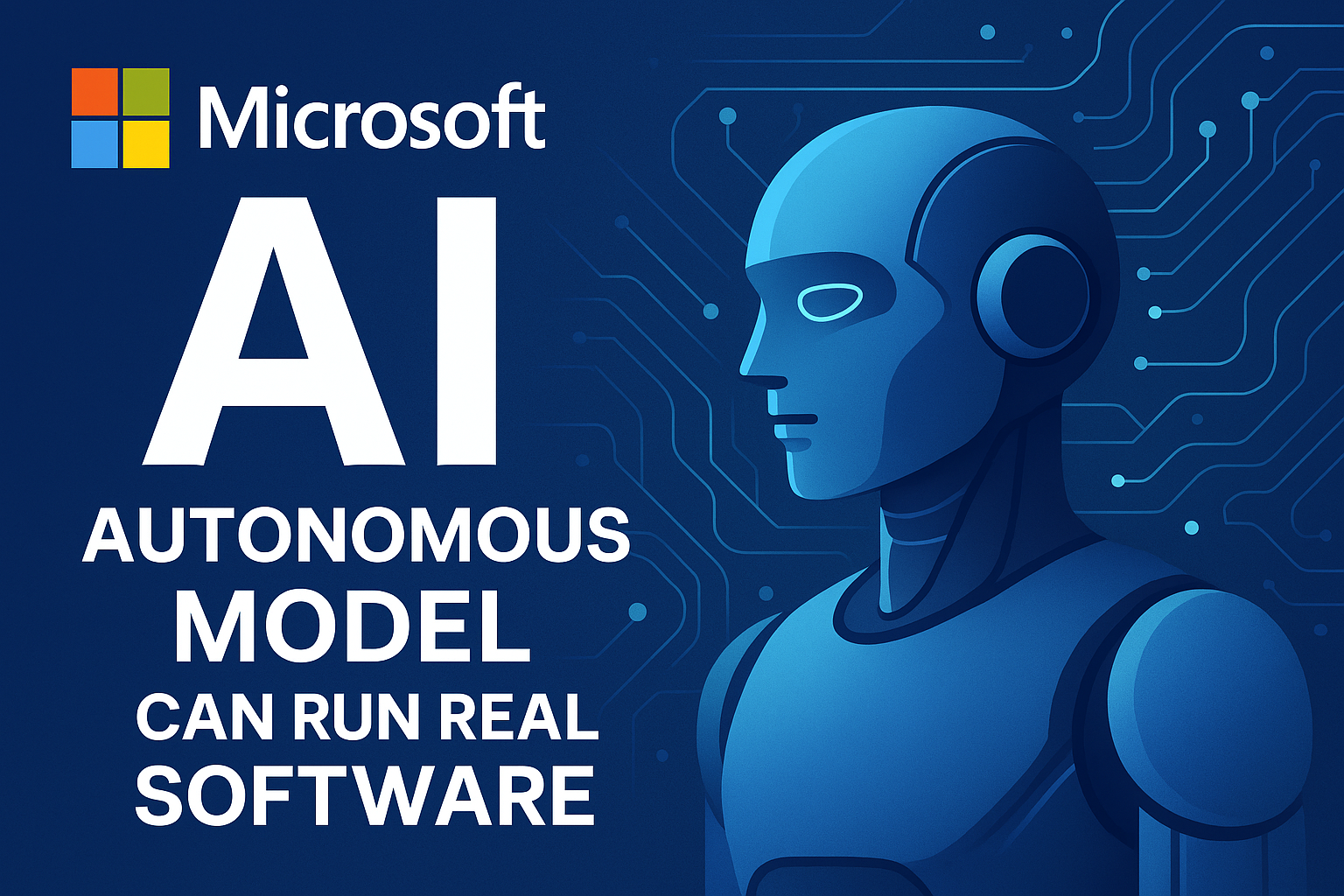
Microsoft AI has entered a new era with the introduction of an autonomous model capable of running real software without human input, marking one of the most significant advancements in modern automation. This breakthrough pushes AI beyond text generation and into the realm of operational intelligence, where systems can execute tasks, manage applications, and interact with real environments independently.
The announcement represents a major shift in how AI agents are designed. Instead of functioning as passive tools that wait for user prompts, this new Microsoft AI model acts as an active operator capable of completing multi-step workflows, executing commands, and coordinating software tasks with precision.
A New Era of Autonomous Agents
For years, the tech industry has imagined AI agents that behave like digital coworkers—capable of running applications, managing files, and completing tasks without constant supervision. Microsoft AI is now making that vision tangible.
This new model can:
- Launch and operate desktop applications
- Execute scripts and system commands
- Manage files and folders
- Interact with user interfaces
- Complete multi-step tasks without repeated prompting
It’s a shift from “AI as an assistant” to “AI as an operator.”
How It Works: A Hybrid Architecture
The system uses a hybrid architecture that blends natural language reasoning with a deterministic execution engine. The LLM handles planning and decision-making, while a secure action layer performs the actual operations.
This separation ensures:
- Safety: The execution layer enforces strict permissions.
- Reliability: Actions are consistent and predictable.
- Traceability: Every step is logged for auditing.
This design allows Microsoft AI to think flexibly while acting with precision.
Real-World Use Cases
The potential applications are broad and transformative.
1. Enterprise Automation
Companies can automate repetitive workflows such as:
- Report generation
- Data entry
- Software testing
- System maintenance
This reduces operational costs and increases efficiency.
2. IT and DevOps
The model can assist with:
- Deploying applications
- Running diagnostics
- Managing servers
- Executing scripts
It becomes a reliable assistant for technical teams.
3. Personal Productivity
For everyday users, Microsoft AI could:
- Organize files
- Edit documents
- Manage emails
- Run apps and complete tasks automatically
It’s like having a digital personal assistant that actually performs the work.
Safety and Governance: A Core Priority
Allowing an AI to run real software introduces risks, and Microsoft has addressed them with a multi-layered safety framework:
- Permission gating: The AI can only perform approved actions.
- Sandboxing: Tasks run in isolated environments.
- Audit trails: Every action is recorded.
- Fallback logic: The AI pauses when uncertain.
This ensures autonomy without sacrificing control.
A Glimpse Into the Future of Operating Systems
This innovation hints at a future where operating systems are not just platforms but intelligent environments capable of managing themselves. Imagine Windows or Azure systems that:
- Self-optimize
- Self-repair
- Self-configure
- Self-manage workloads
Microsoft AI is laying the foundation for that future.
Industry Impact and Competitive Pressure
The release positions Microsoft ahead in the race for autonomous AI agents. While competitors like Google, OpenAI, and Anthropic explore similar concepts, Microsoft’s integration with real software environments gives it a unique advantage.
This move is likely to accelerate innovation across the industry, pushing others to develop their own operational AI frameworks.
The Road Ahead
Microsoft plans to expand the model’s capabilities, including:
- Multi-agent collaboration
- Cross-device task execution
- Autonomous project management
- Real-time learning from user workflows
The long-term vision is clear: AI that doesn’t just assist—but operates.
Conclusion
Microsoft AI’s new autonomous model marks a turning point in the evolution of intelligent systems. By enabling AI to run real software independently, Microsoft has opened the door to a new era of digital productivity, enterprise automation, and system intelligence.
This is more than an upgrade—it’s the beginning of a future where AI becomes an active participant in our digital lives, not just a passive tool.
Fun Fact
The idea of autonomous software agents dates back to the 1990s, but early attempts failed due to limited computing power. Today’s AI models finally make that decades-old vision possible.